Bug Visual Checklist: Common Clues, Lookalikes, and Next Steps
Quick visual checklist for bug visual clues: identify reliable on-photo signs, spot common lookalikes, and follow safe next steps to verify an uncertain match.
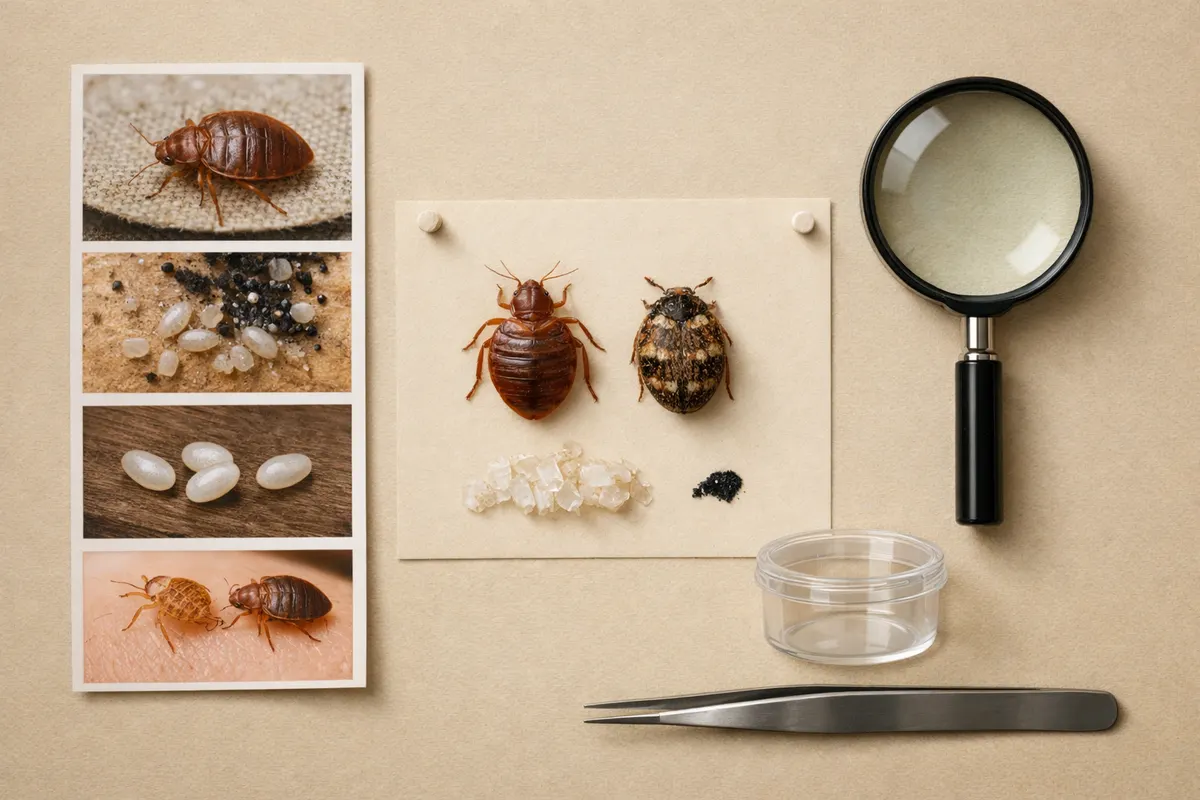
Quick answer for bug visual clues
Bug visual clues are the clear, repeatable signs you can see in a photo that help narrow what kind of insect or arthropod you’re looking at. Focus first on body shape, number of visible legs, antennae, wing structure, and scale—those items usually separate broad groups like beetles, flies, moths, and spiders.
A single photo often points to a short list of possibilities rather than a single confirmed ID. Use visible patterns and context as a triage: note the strongest clues, rule out obvious lookalikes, and treat uncertain matches as research notes that need extra photos or expert verification.
What it means
When people search for bug visual clues they usually want simple, observable features they can check quickly in a picture. These clues are not a final identification; they’re signals you can use to eliminate broad groups and prioritize follow-up checks.
Concrete examples: a rounded, hard-shelled body and visible wing-covers (elytra) strongly point to a beetle. A single pair of wings and a compact body often indicate a fly. Long, segmented antennae and three pairs of legs almost always mean you’re looking at an insect, not a spider or mite.
Photos, scale, and behavior context are part of the meaning. A close-up of a wing pattern matters far more when you also know the size of the insect, the plant it was on, or the time of day the photo was taken.
Key clues
Use the list below as a prioritized visual checklist. Start with the broadest, most reliable clues and move to finer details only when the photo quality and angle support them.
Not every photo will show every clue; mark which clues are visible, which are ambiguous, and which are missing before concluding.
- Body plan: Is the body segmented into head–thorax–abdomen (typical insects) or fused (some mites and ticks)? Clear segmentation rules out non-insect arthropods.
- Leg count and placement: Count visible legs. Six legs = insect (with exceptions if legs are hidden). Eight legs = arachnid (spiders, ticks). Note whether legs originate from the thorax or the body’s midsection.
- Wings: One pair vs two pairs, presence of wing-covers (elytra), wing venation patterns, and whether wings fold flat over the back are strong identifiers for orders like Diptera (flies), Coleoptera (beetles), and Lepidoptera (moths/butterflies).
- Antennae shape and length: Clubbed, filiform, serrate, feathery—antennae dramatically narrow options. For example, feathered antennae on a night-time moth suggest a male moth of many species.
- Head and mouthparts: Visible chewing mandibles, piercing-sucking proboscises, or elongated snouts (weevils) point to specific feeding groups and help rule out lookalikes.
- Color and pattern: Note disruptive markings, longitudinal stripes, spots, or metallic sheen. These are useful but can be misleading if the photo is overexposed or the specimen is a worn adult.
- Size and scale: Always include a reference—coin, ruler, fingertip. Size separates groups (e. g. , small springtails vs larger true bugs) and is essential to avoid misidentification.
- Leg and body texture: Presence of dense hairs, spines, or granular texture can separate species or families (e. g. , hairy caterpillars vs smooth larvae).
- Contextual clues: Host plant, substrate (soil, wood, indoor), behavior (feeding, mating, resting), and time of day provide ecological context that refines visual clues into realistic candidates.
- Damage signs: Feeding marks on leaves, bore holes, or frass can indicate larvae or adult feeding habits and support an ID even when the insect is not fully visible.
Step-by-step workflow
Treat identification as a short investigation. Follow these steps in order so you capture the most useful evidence and avoid false certainty from a single ambiguous clue.
Work quickly but deliberately: take notes on what you can confirm visually, what you infer from context, and what remains unknown.
- 1) Secure a clear image: if possible, take multiple photos from different angles (dorsal, lateral, head-on) and include a scale object. Sharp focus on the head and thorax is usually most helpful.
- 2) Record context: note location, substrate, host plant, time of day, and behavior. These facts narrow the candidate list more than fine color variations.
- 3) Apply the priority checklist: body plan → leg count → wings → antennae → mouthparts → size → texture → color/pattern. Mark each clue as present, absent, or unclear.
- 4) Rule out obvious lookalikes: for example, tiny beetles vs ticks (check for wing-covers and six vs eight legs), or caterpillars vs sawfly larvae (number and placement of prolegs).
- 5) Seek corroborating evidence: if the photo suggests a pest, look for feeding damage or frass. If you suspect a protected or medically important species, pause and gather more images or consult a specialist.
- 6) Use the result as a research note: create a short list of plausible families or genera rather than one definitive name, and plan follow-up photos or expert checks for high-stakes questions.
Examples
Example 1 — Backyard beetle: A 1 cm rounded insect with shiny, hardened wing-covers and a visible seam down the back is almost certainly a small beetle. If antennae are elbowed and clubbed, you’re likely looking at a scarab or related family.
Example 2 — Indoor small black speck: A tiny, dark oval on a mattress could be a bed bug nymph, a peppered carpet beetle, or simply debris. Key checks: leg visibility (six vs none), flattened body shape typical of Cimicidae (bed bugs), and location—bites or fecal marks increase concern.
Example 3 — Caterpillar lookalike: A segmented, soft-bodied larva on a leaf with multiple prolegs in the middle of the abdomen is a caterpillar (Lepidoptera). If prolegs are fewer and arranged differently, it could be a sawfly larva (Hymenoptera), which has different mouthparts and host preferences.
Example 4 — Winged visitor at night: A nocturnal flying insect with feathery antennae and scale-covered wings suggests a moth. If the antennae are threadlike and the wings are narrow with a club near the tip, it may be a small micro-moth instead—scale condition and wing shape matter for finer separation.
Limitations
A single photo has clear limits. Lighting, angle, partial occlusion, worn specimens, and immature life stages can hide or distort the very clues you depend on. Treat one-photo IDs as provisional.
Some lookalikes are notoriously tricky on images alone: tiny beetles vs ticks, moth larvae vs sawfly larvae, and juvenile orthopterans vs certain katydid nymphs. When identification matters for health, agriculture, or legal reasons, use multiple photos and authoritative verification.
Practical outcomes should reflect confidence levels: label a match as “probable family,” “possible species,” or “uncertain. ” When the stakes are high—medical concern, invasive species, protected species—seek a local entomologist, extension service, or professional diagnostician.
If you rely on an app or online tool, keep your findings as part of the evidence chain, not the final word. Apps are great first passes for sorting possibilities, but they do not replace expert verification when risks or regulations are involved.
Related guides
Try Bug Identifier after you check visible clues
Use Bug Identifier as a first-pass companion after you’ve recorded clear visual clues and context. Treat the app’s suggestions as research notes: collect more photos and seek expert verification for high-stakes or uncertain matches.

Frequently asked questions
How many clear photos should I take to improve an ID?
Aim for at least three: a dorsal (top) view, a lateral (side) view, and a close-up of the head or any distinctive feature. Include a scale reference like a ruler or coin and capture the substrate and host plant for context.
Can a single photo confirm whether a bug is dangerous or venomous?
No. A single photo can suggest groups that include dangerous species, but it cannot reliably confirm venomosity or medical risk. If exposure or bites are a concern, treat the situation cautiously and consult a medical or public-health professional.
What are common photo pitfalls that cause misidentification?
Blur, poor lighting, extreme zoom that crops out scale, and unusual angles. Also, worn, faded, or immature specimens often lack the diagnostic marks used for adult identification, which increases the chance of false matches.
When should I seek an expert instead of relying on visual clues alone?
Seek an expert when the insect may be invasive, protected, medically important, or damaging to crops or structures. Also consult specialists when IDs will affect regulatory action, treatment decisions, or scientific records.