Insect Visual Checklist: Common Clues, Lookalikes, and Next Steps
Practical insect visual clues to spot, compare, and verify. Learn what to photograph, common lookalikes, and safe next steps when an ID is uncertain.
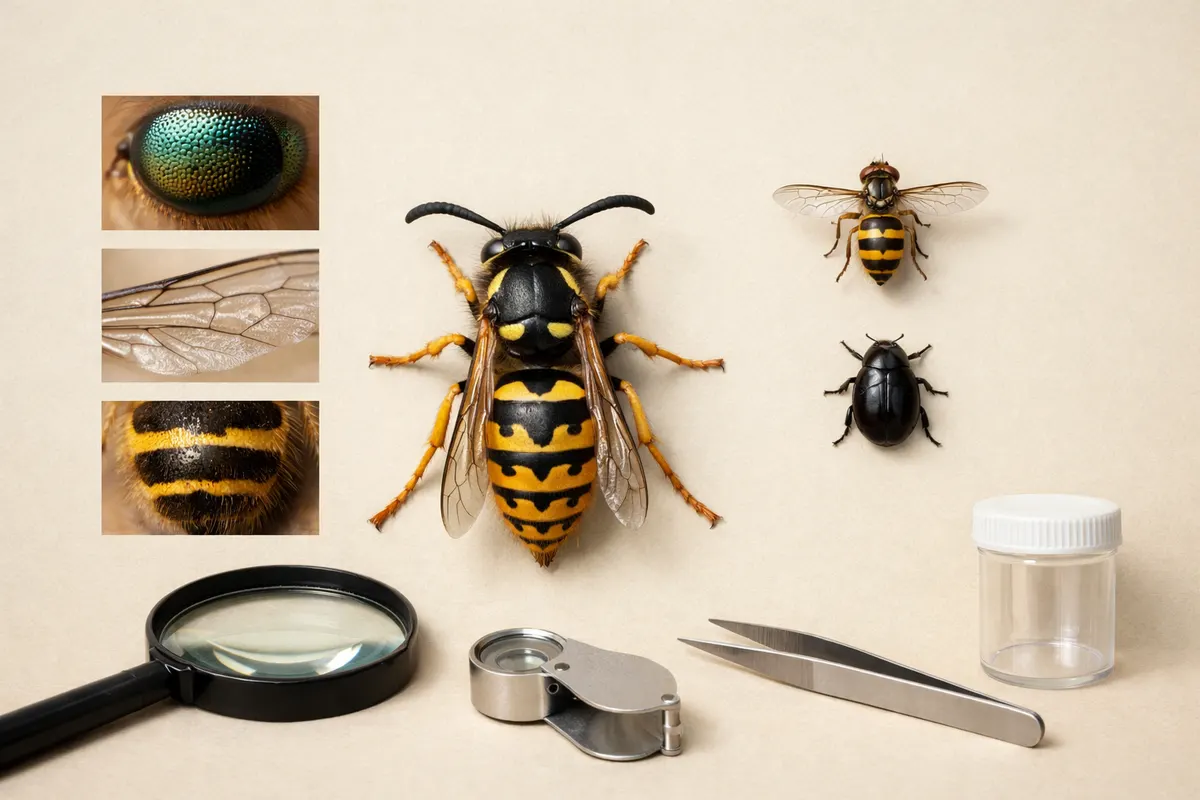
Quick answer for insect visual clues
Insect visual clues are the observable traits and context you can use to narrow an identification from a photo: body shape, wing type, leg arrangement, antennae, size with scale, color patterns, behavior and where the insect was found.
A clear set of photos plus a few context notes (date, location, what it was on) often lets you place a specimen into a group—beetle, fly, moth, ant, etc. —but rarely proves a species-level ID by itself.
Treat a single image as a lead: check the strongest clues listed below, compare with known lookalikes, and use the result as a research note rather than a final answer.
- Start with body plan first: beetles usually show hardened wing covers, flies have one true pair of wings, and ants or wasps often show a narrow waist.
- Add context such as host plant, indoor or outdoor location, season, and behavior so the visual match is not based on color alone.
What it means
When people search for insect visual clues they want quick, practical signals they can see in a photo or in the field. These clues are visual features, photographic quality signs, and contextual details that change how confident you can be about an identification.
A ‘clue’ can be morphological (for example, hardened wing covers on beetles), behavioral (jumping hind legs on grasshoppers), photographic (presence of scale or ruler), or environmental (on a specific host plant). Each clue raises or lowers your confidence in matching a photo to a known insect.
The goal is not always a species name. Often a correct higher-level placement—order or family—is enough to decide if the insect is harmless, a pest, or needs expert attention.
- Strong clues can point to an order or family; weak clues only suggest a possible match that needs comparison.
- Color helps, but shape, wing structure, antennae, legs, and habitat usually carry more identification weight.
Key clues
Start with broad, high-confidence traits that quickly narrow possibilities. These include body plan (three distinct regions: head, thorax, abdomen), wing type (two wings vs. four, hardened elytra), visible mouthparts, and number and placement of legs.
Photographic clues matter. A scale object (coin, ruler), a close lateral view of the body, and a clear shot of the head or wing pattern are the single most useful photos for identification.
- Body shape and segmentation: compact rounded beetles, long narrow weevils, or slender wasp-like bodies.
- Wings and wing covers: elytra on beetles, scaled wings on moths/butterflies, halteres (small balancing organs) on true flies.
- Antennae form: filiform (thread-like), clavate (clubbed), pectinate (comb-like) — antennae are diagnostic for many groups.
- Legs and locomotion: saltatorial hind legs for jumping insects, raptorial forelegs for mantids, or long slender legs for crane flies.
- Mouthparts visible: chewing (mandibles), piercing-sucking (mosquitoes, aphids), siphoning (butterflies).
- Color pattern and texture: spots, stripes, metallic sheen, dense hairs — useful but sometimes variable by sex or season.
- Contextual clues: host plant, substrate (wood, soil, stored product), time of day and season.
Step-by-step workflow
1) Photograph with intent: take multiple, well-lit photos from different angles—dorsal (top), lateral (side), head-on, and a close-up of distinguishing details. Include a coin or ruler for scale when possible.
2) Record context: note where you found the insect (on a plant, inside the house, under bark), the substrate or plant species if known, time of day, and behavior observed (flying, crawling, feeding).
3) Triage with high-confidence clues: use body plan, wing type, antennae, and leg arrangement to place the specimen into a broad group (beetle, fly, moth, wasp, etc. ). This reduces false leads quickly.
4) Compare and verify: check a couple of trusted references or field guides focused on your region. Use identification tools only as a first pass; treat automated matches as candidate IDs that need confirmation with additional clues.
- Take at least three photos: top view, side view, and a close-up of the head, antennae, wings, or markings.
- Write down the setting before comparing matches: garden plant, stored food, window screen, soil, wood, water, or indoor room.
Examples
Example 1 — Small round red beetle on a rose leaf: a domed body with visible elytra and short clubbed antennae suggests a ladybird (Coccinellidae). Look for distinct spot patterns and compare with local species to separate native ladybirds from invasive lookalikes.
Example 2 — Long-legged, mosquito-like insect indoors: long legs and delicate body might be a crane fly (Tipulidae), which is harmless, not a mosquito. Check wing venation and mouthparts: crane flies do not have biting mouthparts like mosquitoes.
Example 3 — Hairy caterpillar on a vegetable plant: count prolegs and look for crochets (small hooks) on the prolegs to separate true caterpillars (Lepidoptera) from sawfly larvae (Hymenoptera), which have more prolegs and different crochets.
Example 4 — Ant-like winged insect near lights at night: wing venation and the presence or absence of constricted waist (petiole) help separate termites from winged ants—important when evaluating potential structural pest concerns.
- Use examples as comparison patterns, not final diagnoses; many insects change appearance between juvenile and adult stages.
- When two matches look similar, look for one structural clue that separates them, such as wing count, waist shape, or antenna form.
Limitations
One photo rarely proves a species-level identification. Many diagnostic features require microscopic examination (genitalia, micro-structures) or observation of life stage and behavior. Treat visual matches from a single image as provisional.
Divide outcomes into three practical levels: high-confidence (distinctive, diagnostic features visible), partial-confidence (some key traits visible but important details missing), and uncertain (multiple lookalikes or insufficient photo quality).
When the insect is medically significant (possible venomous bite, sting, or allergen), or when it may cause structural or agricultural damage, escalate beyond a photo: keep evidence, consult pest professionals, or contact an entomologist. Do not handle unknown specimens without protective measures.
If you consider collecting a specimen for verification, follow local rules and guidance: use safe handling, preserve with minimal contamination, and avoid harming protected species. Often better is to supply multiple labeled photos and context notes to an expert rather than sending a captive insect.
- Separate high-confidence, partial, and uncertain outcomes.
- Tell the reader when to verify with a trusted source or professional.
Related guides
Try Bug Identifier as a first-pass after your checks
After you’ve collected clear photos and checked the key visual clues, use Bug Identifier as a first-pass tool to generate candidate matches. Treat app suggestions as leads—record results alongside your photos and context notes, and seek expert verification for medical, structural, or regulatory concerns. Bug Identifier is available on iOS at https://bug-identifier. app/.

Frequently asked questions
Can I identify an insect from a single photo?
Sometimes—if the photo clearly shows highly diagnostic traits (unique wing pattern, distinctive antennae, or an unusual body shape). More often a single image supports identification to a family or genus, not a species. Use multiple angles and context notes to improve confidence.
What are the most helpful photos to take for identification?
Take sharp images with a scale object: dorsal view (top), lateral view (side), a close-up of the head and antennae, and any patterns on wings or elytra. Photograph the environment and the host plant or substrate to provide context.
How do I tell lookalikes apart (for example, moth vs. butterfly or termite vs. ant)?
Compare a few consistent features: moths usually rest with wings flat or tented and often have feathery antennae, while butterflies hold wings upright and have clubbed antennae. Termites lack the constricted waist ants have; examine wing venation and waist shape when visible.
When should I contact an expert or pest control?
Contact an expert if the insect could pose health risks (stinging or biting), if you suspect structural or agricultural damage, or if accurate species identification is required for management. For medical concerns, prioritize a local health professional; for structural pests, seek licensed pest control.