Termite vs Ant: Wings, Waist, Antennae, and Damage Clues
Quick, practical photo clues to tell termite vs ant: antennae, waist, wings, and damage signs plus what to check next and when to call a pro.
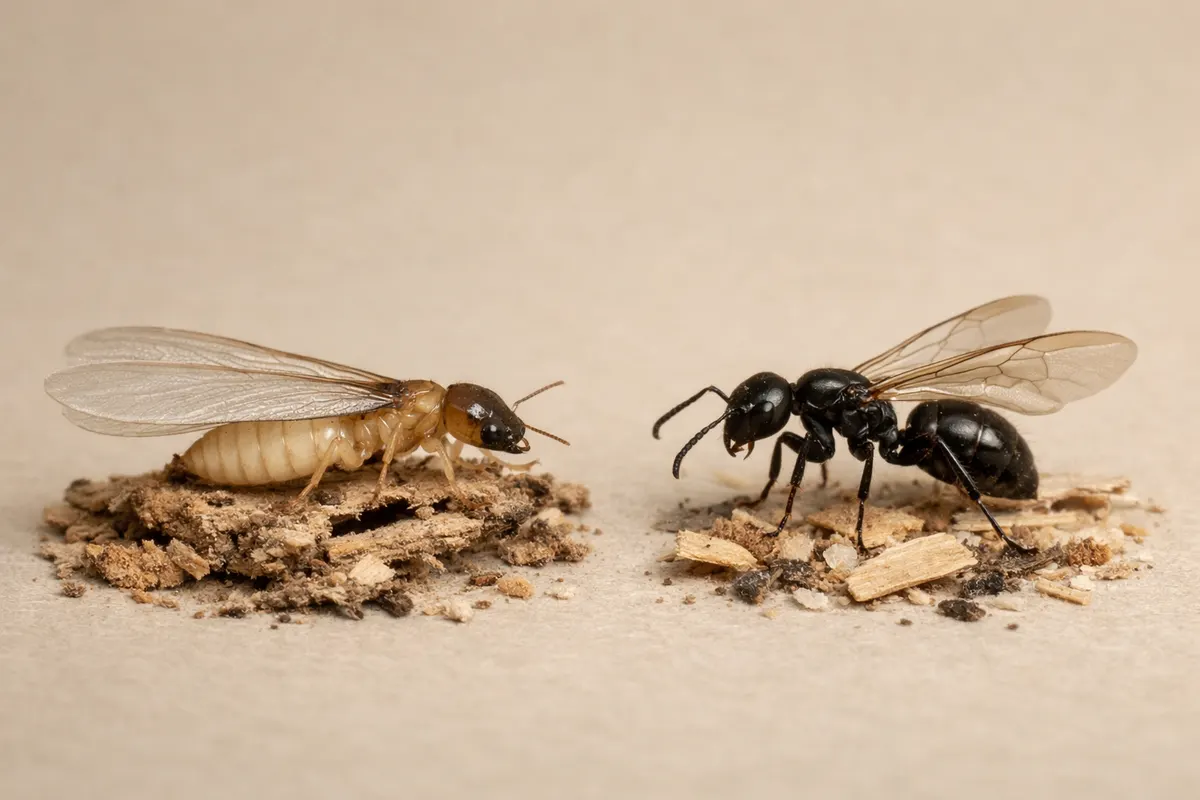
Quick answer for termite vs ant
Termite vs ant can often be sorted with a few visible clues. If the insect has a straight, bead-like antenna, a broad waist, and two pairs of wings the same length, it’s likely a termite. If it has elbowed (bent) antennae, a narrow, pinched waist and front wings longer than the rear wings (or only one wing pair visible on cast wings), it’s probably an ant.
Damage and behavior add context: termites usually leave mud tubes, hollow-sounding or layered wood, and no sawdust piles; carpenter ants leave smooth tunnels and fine frass (sawdust-like debris). Swarm timing and where you find winged insects (near windows, light sources, or emerging from wood) also help narrow the ID.
These clues are reliable starting points but not absolute proof. A single photo that doesn’t show antennae, waist, or wing detail can be ambiguous. Treat on-the-ground checks—looking for mud tubes, frass, or live activity—as part of the identification process before taking action.
- Antennae: straight/beaded = termite; elbowed = ant.
- Waist: broad/indistinct = termite; constricted 'pinched' = ant.
- Wings: two equal pairs = termite swarmer; front pair longer = ant swarmer.
- Damage: mud tubes and layered wood often mean termites; smooth tunnels and frass point to carpenter ants.
Comparison table
Below are side-by-side visual clues, the confidence you can place on each clue in a casual home photo, and practical next steps you can take immediately. Use multiple clues together for a stronger ID.
Confidence here means how reliable the clue is when viewed in a typical smartphone photo from a few inches away. Combine high-confidence clues (antennae, waist, wings) with contextual evidence (damage, shelter tubes, frass) before deciding what to do.
- Antennae — Termite: straight/beadlike. Confidence: high if close-up. Next steps: photograph a clear head-on shot or capture the specimen on a white paper background.
- Antennae — Ant: elbowed (bent). Confidence: high if visible. Next steps: try several angles; the bend is obvious from the side or top.
- Waist — Termite: broad/indistinct. Confidence: moderate-high with a lateral view. Next steps: take a side-view photo that shows the body segments or gently move the specimen into view with a stick.
- Waist — Ant: narrow/wasp-like constriction. Confidence: high if you can see the middle of the body. Next steps: use a ruler or coin for scale if safe to do so.
- Wings — Termite: two pairs equal length, usually longer relative to body. Confidence: high for swarmers. Next steps: photograph wings flat or remove a fallen wing carefully to show veins.
- Wings — Ant: front wings larger than rear wings; wing veins differ. Confidence: high if wings are intact. Next steps: capture a photo of both wings against a contrasting background.
- Damage — Termite: mud tubes, blistered or layered wood, honeycomb interiors. Confidence: high when tubes or internal damage are present. Next steps: inspect crawlspaces, foundations, and wood near soil for tubes or soft wood.
- Damage — Carpenter ant: smooth, clean galleries and piles of wood shavings (frass). Confidence: moderate-high. Next steps: look for frass beneath entry points or in voids and listen for rustling at night.
When to use each
Use visual clues when you have at least one clear photo or a specimen in hand. Antennae and waist shape are the quickest single-image checks. If you can see these strongly, they will usually point you to ant vs termite.
Use damage clues when you suspect infestation but lack a clear insect photo. Mud tubes, hollow-sounding wood, and a lack of frass point toward subterranean termites. If you find fine sawdust and a clean gallery pattern, think carpenter ants.
Use behavior and context for live observations: swarmers near windows or lights in spring are common for both groups, but where they emerged and the presence of associated field signs should guide your next move.
- Have a clear close-up of the head or middle of the body: prioritize antennae and waist checks.
- Found wood damage but no insect: prioritize looking for mud tubes (termite) vs frass or exit holes (carpenter ant).
- Saw winged insects indoors but no damage: capture wings and scale; compare wing length and veins before concluding.
- Unsure after photos: treat results as research notes and escalate with a careful inspection or a professional evaluation.
Common confusions
Winged insects cause the most mix-ups. Termite and ant swarmers both have wings and can look similar at a glance, particularly in low light or when wings are tattered. The fastest check is wing proportion: in termites the fore and hind wings are about the same length; ants have noticeably longer forewings.
Carpenter ants and subterranean termites can both cause structural damage, but the pattern differs. Homeowners often mistake frass for dirt or paint chips—frass is a telltale sawdust-like pile near carpenter ant galleries, whereas termites leave little external debris but may build mud tubes.
Color and size are poor alone: both groups include species from pale cream to dark brown and sizes that overlap. Relying on color without looking at antennae or waist increases the chance of error.
Finally, other insects like flying termites’ close relatives (some wood-boring beetles) or winged wasps can add confusion. Use a combination of body shape, wings, and damage signs rather than a single trait.
- Tattered wings on dead swarmers hide vein patterns—try to capture a fresh specimen or multiple photos.
- Pale ants (some species and castes) can look termite-like in poor photos—focus on antennae shape and the waist.
- Beetle borers leave boreholes and powdery dust rather than mud tubes or frass piles; check the texture of debris.
Verification path
When identification affects repair costs or treatment decisions, follow a verification path: collect evidence (photos and contextual notes), use visible-clue checks, and then decide whether to monitor, try a targeted—non-destructive—test, or contact a professional. Don’t rely on one fuzzy image when money or safety is involved.
Start with photos: take at least three images—a head-on to show antennae, a side view to show the waist, and a close-up of wings if present. Include a size reference such as a coin or ruler in your pictures. Note where the insect was found and any damage you see (mud tubes, frass, hollow wood).
If photos and on-site checks point to termite activity (mud tubes, internal galleries), consider a professional inspection before DIY treatment. If evidence indicates carpenter ants, remove accessible frass, trace galleries to locate nests, and seal entry points where practical.
- Photograph checklist: head-on (antennae), side view (waist), wing detail, context shot showing location and scale.
- Inspect damage: tap wood to check hollowness, probe voids gently, look for mud tubes along foundations or in crawlspaces.
- Short-term action: if you see active swarms indoors or extensive damage, restrict access to affected areas and document everything with photos.
- When in doubt: treat the ID as preliminary research notes. Use a professional inspection for definitive diagnosis or if structural damage is suspected.
Related guides
Check clues, then use Bug Identifier for a first pass
After you gather photos (head, side, wings) and note any damage, use the Bug Identifier app on your device to analyze those images as a first-pass ID. Treat the app’s result as a research note—document what you see, and get a professional inspection if you find mud tubes, extensive damage, or active colonies.

Frequently asked questions
How do I tell a termite from an ant in a single photo?
Look for antennae shape, waist profile, and wing proportions. Straight, bead-like antennae and a broad waist point to termites; elbowed antennae and a pinched waist point to ants. Wings equal in length usually mean a termite swarmer. If those details aren’t visible, the photo alone may be inconclusive.
Does frass always mean carpenter ants and mud mean termites?
Frass (wood shavings) strongly suggests carpenter ant activity but can also come from beetles. Mud tubes and soil-stained tunnels are strong indicators of subterranean termites. Use both debris type and tunnel structure together for a more reliable interpretation.
Are winged swarmers inside the house always a sign of infestation?
Not always. Swarmers indoors can mean a colony nearby, but sometimes they’re attracted from outside by lights. Check where they emerged, inspect nearby wood for damage, and photograph wings and body features before concluding infestation.
Can an app or a single photo give a definitive identification?
No single photo or app result should be treated as definitive for treatments or structural decisions. Apps and photos are useful first passes; combine their suggestions with on-site checks and professional inspection when damage, health, or major repair costs are at stake.