
Bug Identification
Click Beetle: Identification, Habitat, and Real Examples
Identify a click beetle from photos: the long, narrow body, the clicking jump, key facts, where and when you’ll see one, and lookalikes to rule out.
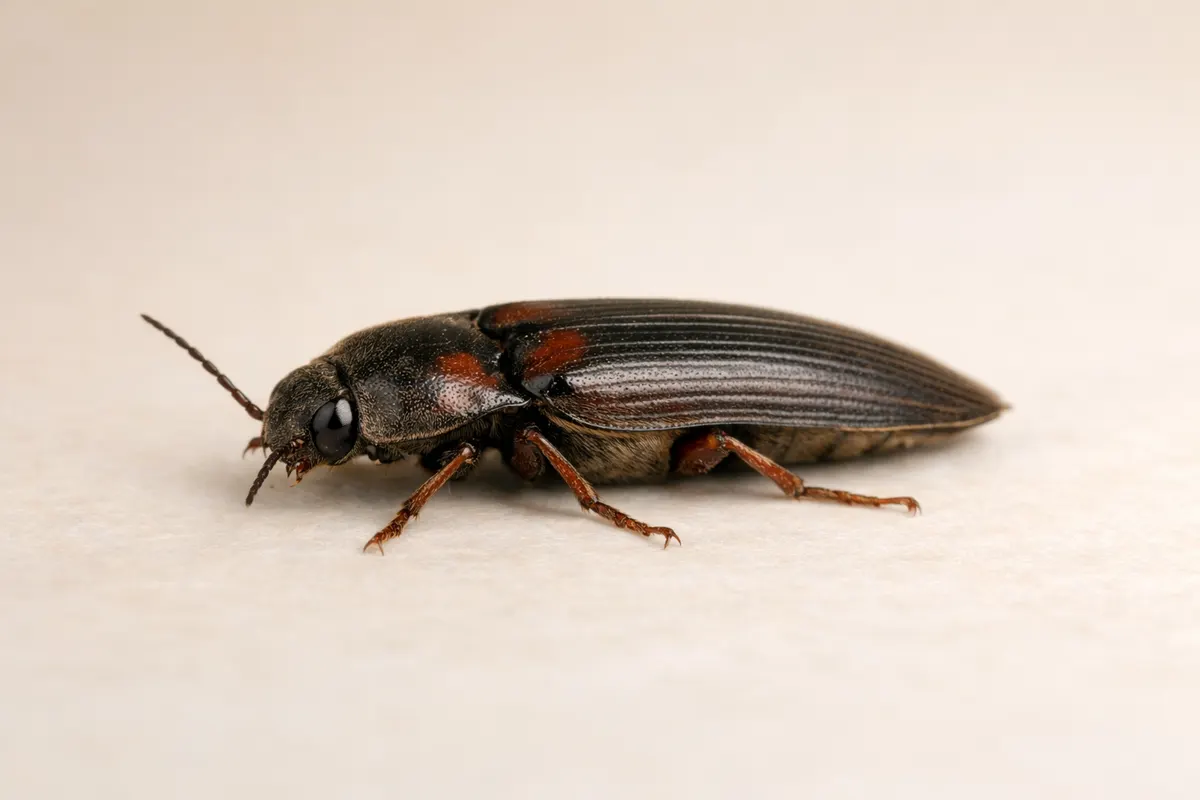
What a click beetle is and why it clicks
A click beetle is a member of the beetle family Elateridae, a group of elongated, hard-bodied beetles found across temperate and tropical regions. Adults typically range from about 6 mm to over 40 mm long depending on species, with many common garden species around 10–25 mm.
Click beetles are best known for a mechanical clicking and flipping action they use to right themselves when overturned. That action comes from a spine-and-groove on the underside of the thorax (the prosternal spine) that snaps into place when the beetle flexes, producing a sharp click and launching the beetle into the air.
Color and pattern vary widely across the family: many are plain brown or black and easily overlooked, while others show stripes, mottling, or conspicuous eye-like spots. The larvae—called wireworms—are slender, hard-bodied grubs that live in soil and can be found feeding on roots and seeds in agricultural and garden settings.
How can you tell a click beetle from a photo?
Start with body shape and posture. Click beetles have a distinctly elongated, somewhat flattened profile with parallel sides and a tapered rear. From above they often look coffin-shaped: long, narrow, and evenly tapered rather than broadly oval or rounded.
Check the pronotum (the plate behind the head): the hind corners are usually pointed or hooked and overhang the base of the wing covers (elytra). That pronounced posterior corner is a quick photographic clue because many lookalikes lack that overhanging edge.
Photograph the underside when possible. The prosternal spine and matching groove on the mesosternum are the mechanical parts of the clicking mechanism; a clear underside shot can confirm the structure. If you can’t get an underside shot, a photo that captures the lateral silhouette and the pronotal corners still supports an ID.
Look at antennae and surface texture. Many click beetles have serrate (saw-like) or filiform antennae rather than the long, whip-like antennae of roaches. Surface texture also helps: click beetles usually have firm, often matte elytra with fine punctures, not the glossy, flexible wing bases of some other beetle families.
- Parallel-sided, elongated body rather than broadly oval.
- Pronotum with hooked or pointed rear corners that overhang the elytra base.
- Prosternal spine visible on the underside (best confirmation).
- Serrate or bead-like antennae instead of long, feathery, or filamentous types.
- For broader comparisons, see Beetle Identification: Visual Clues and Safe Next Steps for photo-check tips and angles to capture.
Click beetle — key facts at a glance
This compact table lists the common field attributes photographers and finders can check quickly. These are general traits across Elateridae; individual species can fall outside these norms.
| Attribute | Typical |
|---|---|
| Size | Most adults 6–40 mm (small garden species to larger forest species) |
| Colouring | Brown, black, mottled, striped, or with pale spots; some species show eye-like marks |
| Habitat | Gardens, fields, grassland margins, woodland edges, and occasionally indoor lights |
| Active season | Warm months in temperate zones (spring through autumn); nocturnal activity and attraction to lights |
| Distinguishing feature | Prosternal spine and overhanging pronotum corners linked to clicking/flip behavior |
Where and when you'll encounter a click beetle
Click beetles are broadly distributed and appear in habitats where their larvae or adults can find food and shelter. Adults are most often noticed at night near lights or resting on vegetation during the day, while larvae (wireworms) live in soil and are encountered in agricultural or garden settings.
Seasonal activity varies with climate: temperate regions see most adult activity from late spring through early fall. In warmer climates adults can be present year-round, with peak appearances tied to local wet seasons or crop cycles.
Photographers and homeowners most often report click beetles when checking porch lights, turning over logs or mulch, or examining potted plants. If you’re monitoring for crop damage, wireworms in soil are the stage to watch for rather than the adult beetle.
| Region or habitat | When you'll see it | What you'll notice |
|---|---|---|
| Gardens and lawns | Spring–autumn evenings | Adults on plants or attracted to porch/yard lights |
| Agricultural fields | Seasonal peaks tied to crop growth | Wireworms in soil; adult beetles near field edges |
| Woodland edges and under bark | Warm months, during the day when disturbed | Elongated beetles on mulch, logs, or leaf litter |
| Indoors near lights | Nighttime, when lights are on | Single beetle near windows or indoor lamps |
Species and insects commonly mistaken for click beetles
Click beetles are regularly confused with a handful of other beetles and with cockroaches because of a similar size and brown coloration. A careful look at body shape, antennae, and the pronotum corners will sort most photos.
Ground beetles and darkling beetles can appear superficially similar but usually have broader bodies and different leg posture. Cockroaches are flatter and show a different head-thorax relationship and longer, filamentous antennae.
Some large click beetles are distinctive enough to be recognized to a common name, and those species are worth learning because they look unlike small, plain species and therefore cause fewer misidentifications.
- click beetle vs cockroach — cockroaches are broader, more flexible-bodied, and have longer filamentous antennae; click beetles are more elongated with pronounced pronotal corners.
- Ground beetles (Carabidae) — usually faster runners with visible necks and different leg placement; they lack the overhanging pronotal corners of many click beetles.
- Darkling beetles (Tenebrionidae) — often robust and rounded with fused elytra; click beetles are more tapered and have a functional prosternal mechanism.
- eyed click beetle — a common large species with white, eye-like spots on the elytra and pronotum; its size and markings separate it from small, plain click beetles and from lookalike beetles.
Care and handling
Handle click beetles gently if necessary. They do not bite or sting, but heavy handling stresses the insect and can damage the prosternal mechanism. Use a soft brush or container to move individuals for a closer photograph.
For a photo useful to identification, aim for multiple angles: dorsal (top), lateral (side), close-up of the pronotum corners, and an underside shot if you can get it without harming the beetle. Include a small scale (a coin or ruler) and note the date and location for context.
Avoid pesticide use as a first response unless you have clear evidence of damaging larvae and a vetted management plan. If you suspect agricultural damage from wireworms, consult local extension resources for legal and safe control options rather than assuming household treatments will work.
Frequently asked questions
How can I be sure a beetle I photographed is a click beetle and not a similar beetle?
Compare the photo to a few visual checkpoints: an elongated, parallel-sided body; pronotum with hooked rear corners that overhang the wing covers; and, if available, an underside shot showing the prosternal spine. Antennae shape and surface texture also help. If several of these features match, the photo supports a click beetle identification, but a single unclear angle cannot confirm species-level identity.
My garden seedlings are wilting—could click beetle larvae be the cause?
Wireworms (click beetle larvae) feed on roots and germinating seeds and can damage seedlings. Finding adults nearby adds context but is not proof of larval presence. Confirm larvae in the soil before assuming the cause; trap tests or soil inspections that reveal wireworm-shaped grubs support the diagnosis and guide management.
What should I include in photos to make visual identification of a click beetle more reliable?
Take multiple in-focus shots: a clear dorsal view, a close crop of the pronotum and elytra, a lateral silhouette, and an underside image if you can safely get it. Add a scale object, note the location and date, and avoid strong shadows or motion blur. These elements let reviewers check the pronotal corners, body proportions, and antennae that distinguish click beetles from lookalikes.
When I find a brown beetle in my basement at night, how do I tell a cockroach from a click beetle?
Cockroaches have a broader, flattened body, a visible head with long filamentous antennae, and a flexible plate-like pronotum that conceals the head; click beetles are more elongated with pronounced pronotal corners and serrate antennae. Lighting and a clear side or dorsal photo make this distinction straightforward in most cases.
Related guides
Compare your photo to click beetle clues with Bug Identifier
If you’ve photographed a beetle and want a quick second look, use Bug Identifier as a first-pass tool to compare your image against the visual clues on this page. Treat the app as an evidence-check: it can highlight features to re-photograph and point out likely lookalikes, but it does not replace expert verification. Visit https://bug-identifier.app/tools/bug-identifier to try that comparison and to find tips on the best photos to capture for a stronger ID.
Take the next step →