
Bug Identification
Yellow Sac Spider: Identification, Habitat, and Real Examples
Learn which visible clues a photo can prove for the yellow sac spider, what lookalikes to check, and the next evidence steps before you trust an ID.
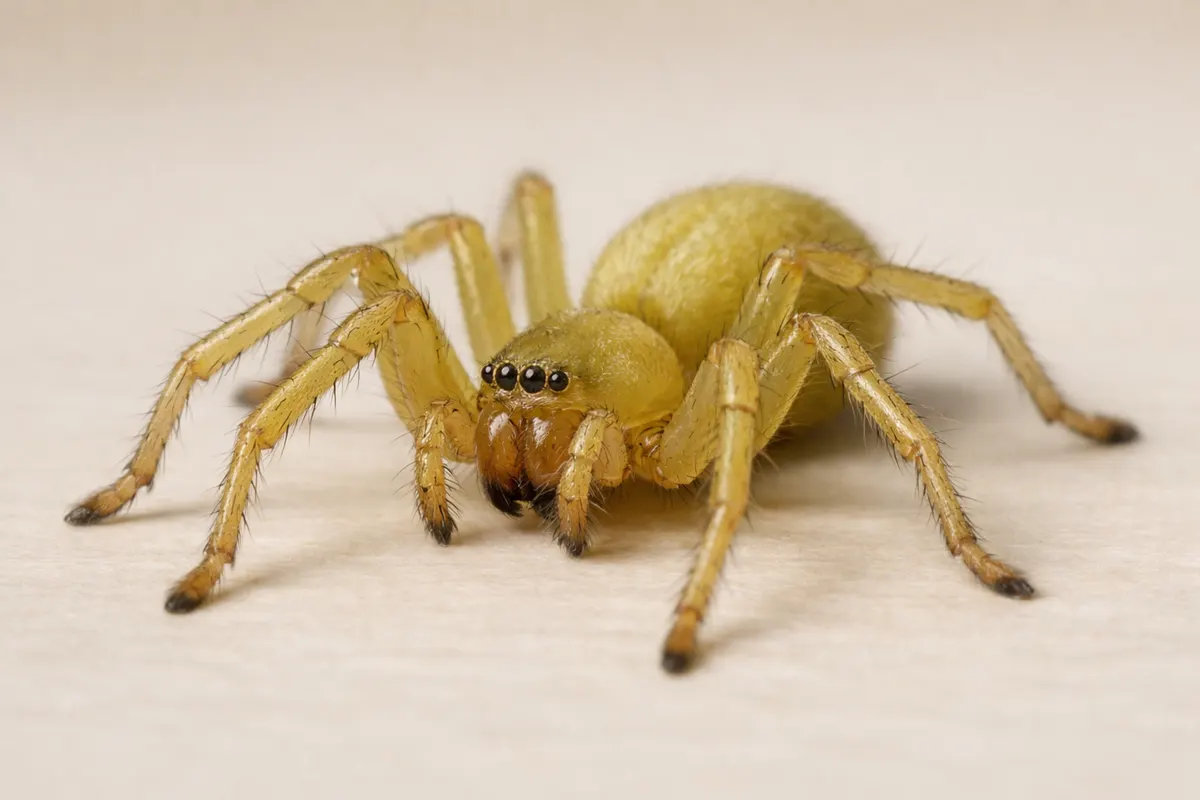
What the yellow sac spider is and why it’s noticed
The yellow sac spider (genus Cheiracanthium) is a small, pale hunting spider often found near human structures. Adults are typically 5–11 mm body length (legs extend further) and are usually beige to pale yellow with a slightly darker abdomen or faint dorsal stripe. They belong to the family Cheiracanthiidae and are best known for building short silk “sacs” where they rest during the day.
These spiders are nocturnal hunters rather than web trappers: they roam walls, ceilings, and foliage at night to hunt small insects. Because they frequently occupy indoor corners, light fixtures, and the undersides of leaves, people often encounter them in houses, garages, and garden plantings.
When a photo shows a small pale spider tucked in a smooth silk tube near a ceiling or window trim, that observable behavior—combined with size and color—supports a yellow sac spider identification. Still, some pale spiders share similar habits and colors, so multiple photo angles and contextual notes (time of day, where the spider was found) strengthen the case.
- Genus: Cheiracanthium (family Cheiracanthiidae); small, pale hunting spider.
- Typical adult body length: 5–11 mm; legs make it appear larger.
- Behavioral clue: rests in short silken sacs on walls, window frames, or plant undersides.
How can you confirm a yellow sac spider from photos?
Start with three photo angles: dorsal (top), lateral (side), and a close crop of the legs and abdomen. Dorsal shots show overall coloration and any faint dorsal stripe; lateral shots reveal the tube-shaped body and leg posture; close crops can show leg spines and the silk sac if present.
Look for a combination of visible clues rather than a single mark. Helpful photo-checkable signals include the pale yellow-beige color, elongated abdomen without strong banding, relatively long legs with fine spines, and presence of a small smooth silk tube tucked into a corner or leaf fold. A single close-up of a living spider on a light background can allow these checks.
Things photos usually cannot confirm: exact species inside Cheiracanthium (multiple species look similar), detailed eye arrangement, or microscopic genital features used for species-level ID. If you need higher confidence, capture the specimen gently (see care section) and photograph it on a neutral background with a scale reference.
Document context: note time of day, precise location (indoors ceiling, window trim, garden foliage), and behavior (found resting in a silk tube vs actively running). These metadata often point away from lookalikes and make a photographic ID much more reliable.
- Essential photo angles: dorsal, lateral, and a close crop of the legs/abdomen with scale.
- Visible clues to check: pale yellow-beige color, long legs with fine spines, small silk sac nearby.
- Limits of photos: species-level ID and eye pattern usually require microscopy or an expert exam.
Key facts and quick reference for the yellow sac spider
The table below summarizes the concise attributes useful for quick recognition and reporting. Use these fields as a checklist when examining photos or notes.
After the table, read the short notes about variability: color can vary from nearly white to tawny, and juvenile proportions differ from adults, so always compare multiple clues rather than color alone.
| Attribute | Typical Details |
|---|---|
| Body length | 5–11 mm (adult) |
| Coloring | Pale yellow to beige, sometimes faint darker dorsal mark |
| Habitat | Indoor corners, window frames, foliage undersides, lighted porches |
| Active season/time | Most visible spring–autumn; nocturnal hunters |
| Distinguishing feature | Short smooth silk sacs used as daytime retreats |
- Size and color vary by species and age; use multiple clues for ID.
- Silk sac presence is a strong behavioral indicator when visible in photos.
- If you plan to keep a specimen for closer study, label location, date, and time of day.
Where and when you’re most likely to see a yellow sac spider
Yellow sac spiders are widespread in temperate regions and adapt readily to human spaces. You’ll commonly find them in houses, sheds, garages, and gardens across North America and Europe, although specific Cheiracanthium species appear in other regions as well.
They are most active at night when they hunt; daytime encounters are often the result of disturbing a resting sac. Indoor sightings increase in late summer and early fall when juveniles and dispersing adults are more abundant.
When checking photos or notes, the setting gives strong identification weight: a pale, small spider found inside a ceiling corner or behind curtains that’s associated with a neat silk tube is consistent with a yellow sac spider. Conversely, an outdoor photo taken on rough bark or deep leaf litter may point to other pale ground-dwelling spiders.
| Region or habitat | When you'll see it | What you'll notice |
|---|---|---|
| Indoors (ceilings, corners, curtains) | Anytime; more often found in daytime resting sacs | Pale spider near a small smooth silk tube |
| Porch and lighted exterior walls | Night; attracted to insect prey around lights | Active running on walls or under eaves after dark |
| Garden plants (undersides of leaves) | Night; rests in folded leaves by day | Silk sac tucked into leaf fold; pale body |
| Garages and sheds | Late summer to autumn; juveniles dispersing | Small pale spiders on stored items or walls |
- Indoor corners, window frames, curtain folds — look for small silk sacs.
- Nocturnal: most hunting occurs after dark; daytime sacs are resting spots.
- Seasonal peak: late spring through autumn for visible adult activity.
Yellow sac spider vs brown recluse: how photos separate them
Two spiders are commonly mixed up in photos: pale sac-type spiders and the brown recluse (Loxosceles reclusa). The brown recluse is a different genus and has diagnostic traits that are usually visible in good photos: a uniformly brown body, the characteristic violin-shaped marking on the cephalothorax, and a distinct eye pattern of six eyes arranged in pairs (most spiders have eight).
By contrast, yellow sac spiders are paler, often show a smooth pale silk sac nearby, and lack the clear violin mark and the six-eye layout. If a photo shows a pale yellow spider tucked into a silk tube, it more likely points to Cheiracanthium than Loxosceles.
When a photo is ambiguous—blurry, poorly lit, or missing scale—note the context and collect better images if possible: a clear dorsal shot that reveals the violin mark (or lack of one) and a close-up of the cephalothorax are especially helpful for separating these two groups.
- Yellow sac spider: pale yellow/beige, silk sac, longer legs; often seen on walls and window frames.
- Brown recluse: uniform brown, violin mark on the cephalothorax, six eyes in pairs; rarely builds a silk sac.
- If unsure from a photo, capture clear dorsal and cephalothorax-focused shots or consult a specialist.
Care, handling, and safety around yellow sac spiders
Handle with caution: these spiders are small but can bite if provoked. Avoid bare-hand capture; use a jar and a stiff card or wear gloves if you must move the spider. Placing a clear container over the spider and sliding a card beneath it is a low-risk method to photograph or relocate the specimen.
If you’re documenting a specimen for identification, photograph it in the container against a neutral background with a scale reference (ruler or coin) and note location, date, time, and behavior. If relocation is your choice, release it outside away from doors and windows rather than keeping or transporting live animals without knowing local wildlife regulations.
If bitten and you suspect a yellow sac spider bite, wash the area with soap and water, apply a cool compress, and monitor symptoms. Most bites cause local redness and minor pain; severe reactions are uncommon but possible. Seek medical attention if you experience progressive swelling, spreading redness, systemic symptoms, or if you are concerned; do not rely on a photo alone to determine medical risk.
- Capture method: jar + card or gloved pick-up; avoid bare-hand handling.
- Documenting for ID: take multiple clear photos with a scale and record time/place.
- Medical note: clean bites, watch symptoms, and see a clinician for worsening signs.
Frequently asked questions
Could this be a yellow sac spider bite after a night-time sting?
A photo of a skin reaction alone rarely proves the cause. Yellow sac spider bites typically produce a small, localized reaction that can include redness, pain, or a blister in some cases, but many other insects and skin conditions look similar. If you suspect a bite from a night-time encounter with a pale spider, document the event (time, what the spider looked like, any photos) and seek medical care if the lesion worsens, spreads, or is accompanied by fever or systemic symptoms. Photographs can help clinicians, but a single image rarely establishes species-level cause.
How can I tell yellow sac spider vs brown recluse when my photo is blurry?
If a photo is blurry, start with context: where the spider was found (indoors ceiling vs dark undisturbed closet), time of day, and whether there was a silk sac nearby. Clear differences include coloration and the brown recluse’s violin-shaped mark and six-eye pattern; these are hard to see in a blur. Try to take additional sharp dorsal and cephalothorax-close-up shots with scale in good light. If clearer photos aren’t possible and you need certainty for medical or safety reasons, preserve the specimen safely in a container and get an expert to examine it.
Can I identify a yellow sac spider from one phone photo alone?
Sometimes a single very clear photo that shows color, body shape, and a nearby silk sac is enough to make a confident identification to genus. More often, however, multiple angles and contextual notes increase reliability. Photos that miss scale, are overexposed, or don’t show the cephalothorax and legs make misidentification more likely. When identification matters—medical response or pest action—gather additional images or consult an expert.
When do yellow sac spiders typically move indoors and what should I watch for?
Yellow sac spiders are most noticeable indoors in late summer and autumn when juveniles mature and adults disperse. Watch window frames, curtain folds, ceiling corners, and lighted porches for pale spiders or small silk sacs. Reducing clutter near entry points, sealing gaps in window and door frames, and minimizing outdoor lighting that attracts prey can reduce indoor encounters. If you find spiders regularly inside, document times and locations to help decide whether exclusion or targeted measures are appropriate.
Related guides
Compare your photo against the yellow sac spider clues
After you check the visible evidence on this page—color, sac presence, and context—use Bug Identifier as an optional next step to compare your photos against known clues. The tool is a helpful first-pass that highlights matching features and suggests follow-up checks; for medical or safety issues, pair any tool result with clinical advice or an expert examination. Learn more and try a guided comparison at https://bug-identifier.app/tools/bug-identifier.
Take the next step →