Spider Identification
Spider Identification: Fast Visual Checks and Photo Triage
Practical spider identification guidance: which visible clues a photo can show, which checks to do next, and how to use a photo ID app safely.
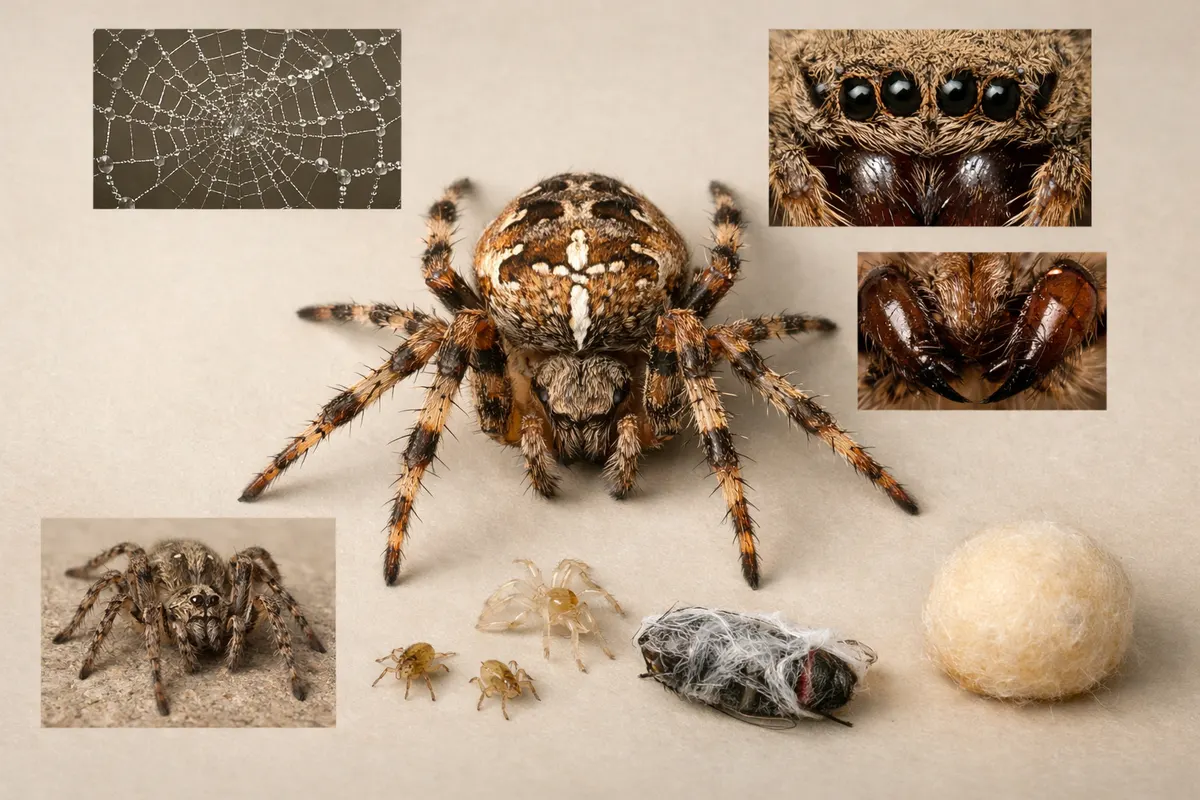
Spider identification starts with observable features a photo can show reliably: body shape, overall color pattern, web or habitat context, and size relative to a common object. An informed first pass narrows the likely group and flags species that merit caution without pretending a single picture is definitive.
A careful photo-first triage helps you decide safe next steps—does the spider look like a common indoor species, a potentially hazardous species, or an inconclusive match that needs better documentation? That short checklist speeds decisions about whether to photograph, contain, or leave the specimen alone.
Using a photo-based ID tool after you collect these clues gives a faster, evidence-focused result: the tool suggests possible identities from visible traits and offers follow-up checks. Treat that outcome as a starting point for follow-up checks rather than a final diagnosis.

How identification works
Step 1
Snap a photo
Take a clear, well-lit photo of your item in the Bug Identifier app.
Step 2
Get an instant identification
The app reads the visible clues and returns the closest matches in seconds.
Step 3
Review the details
Compare the result with your photo, review any uncertainty, and check the suggested next steps.
How to identify a spider by visible signals
Focus on a short list of signals a photograph and quick inspection can confirm. These features typically survive phone photos and tell you the group: body proportion (long skinny abdomen vs. bulbous), overall color and distinct marks, leg length and banding, web type, and where the spider was found.
When photographing, include a scale object and take shots from above and at a shallow side angle if safe. Note habitat: under furniture, in a garage, on a windowsill, or in leaf litter—location narrows likely species groups.
Be explicit about uncertainty. If a spider lacks distinct dorsal markings or is obscured, a confident identification is unlikely from a single image. Document what’s missing as clearly as what you see.
- Body shape: rounded or elongated abdomens occur in several families; combine this clue with web structure and other visible traits.
- Color and marks: distinct violin or dark central mark can be meaningful but are not decisive alone.
- Web and posture: tidy orb webs vs. messy cobwebs vs. wandering hunters help group spiders quickly.
- Size and reference: a ruler or familiar object can help a person judge scale, but do not approach or handle the spider to place one nearby.
What a spider identification result includes
Use a photo identification result as a list of possibilities to investigate. The Spider Identifier suggests likely species or families, describes visible traits and gives next checks. Do not assume it supplies a calibrated confidence score, proves a spider is harmless or replaces an arachnologist’s identification.
The result should list the key visible clues that supported the match—e.g., dorsal pattern, leg banding, or web type—and a short list of likely lookalikes to check against your photos. This transparency helps you understand when a match is tentative because photos lacked detail.
Practical follow-up suggestions are essential: what additional shots to take (close-up of dorsal abdomen, underside if safe), recommended safe handling (avoid touching, photograph from a distance), and whether to seek expert confirmation. The report should never claim medical or legal certainty from a single image.
- Possible identities to compare with local species and field marks.
- Visible-evidence summary showing which marks drove the match.
- Lookalikes or uncertainty notes when provided; absence of a warning is not a safety verdict.
- Suggested next photos to improve confidence and triage guidance.
Black widow spider identification and common lookalikes
Spider identification depends on combinations of traits. A dark, rounded abdomen is not enough to identify a widow, and a violin-like marking alone is not enough to identify a recluse. Many unrelated spiders share colors or markings. Never handle or turn over a suspected widow to look for an hourglass.
Web architecture adds context but is not decisive by itself. Common house spiders can build tangled cobwebs, funnel weavers build sheets leading to a retreat, and orbweavers construct wheel-shaped webs. “Garden spider” is a common name applied to several spiders, including orbweavers; it is not a separate diagnostic category.
UC IPM describes recluse identification using several traits, including six eyes arranged in three pairs, unbanded legs and an unpatterned abdomen. Those features may require magnification and expert review; do not approach a live spider to count its eyes. Geographic range also matters. See https://ipm.ucanr.edu/home-and-landscape/brown-recluse-and-other-recluse-spiders/. For a broader guide to webs and spider groups, see https://ipm.ucanr.edu/home-and-landscape/spiders/.
- Widow comparison: a visible hourglass may support a suspicion; an unseen or unclear marking does not exclude it.
- Wolf spiders and funnel weavers can resemble each other; a blurred side view rarely resolves them.
- Keep the identification unresolved if the necessary features are missing.
Frequently asked questions
How to identify a brown recluse when I find a small brown spider in my basement?
A small brown spider is not automatically a brown recluse. Geography, eye arrangement and several body traits matter together; a violin-like mark by itself is unreliable. Keep your distance, use existing clear photographs if available, and ask a local extension office or arachnologist to review a suspected recluse.
Is this a common house spider if I find webs in my window frame and corners?
A web in a window or corner does not identify its occupant. Different indoor spiders make tangled cobwebs or sheets, and some wander away from webs. Photograph the spider and web from a distance, note where you found it, and compare several traits rather than assuming every indoor spider is the same species.
What visual signs should I check for black widow spider identification in a backyard encounter?
Adult female black widows often have a rounded dark abdomen and a red marking underneath, but appearance varies with age and species. Do not turn over, corner or handle the spider to inspect it. A missing view of the underside cannot rule out a widow; use expert review when the identification matters.
How good do my photos need to be for a useful spider ID result?
Useful photos show clear dorsal and side views, include a size reference (coin or ruler), and capture any distinct markings or web type. Avoid heavy blur, extreme shadows, or only distant habitat shots. If close photos are unsafe, a zoomed shot from a stable distance plus notes about location and behavior improves the app’s match quality. Even a clear photo may leave the identification uncertain; compare suggestions with a reliable local reference.
Related guides
Try a photo-first spider ID with Bug Identifier
Use the Spider Identifier at https://bug-identifier.app/tools/spider-identifier to review possible identities and follow-up checks from a clear photo. Keep your distance and treat the suggestions as provisional. If someone may have been bitten and feels unwell, contact a medical professional or poison center instead of waiting for an app result.