Bed Bug Lookalikes: Beetles, Fleas, Ticks, and Carpet Bugs
Learn which visible traits reliably separate bed bug lookalikes from true bed bugs, which photo clues are weak, and practical next steps before you decide.
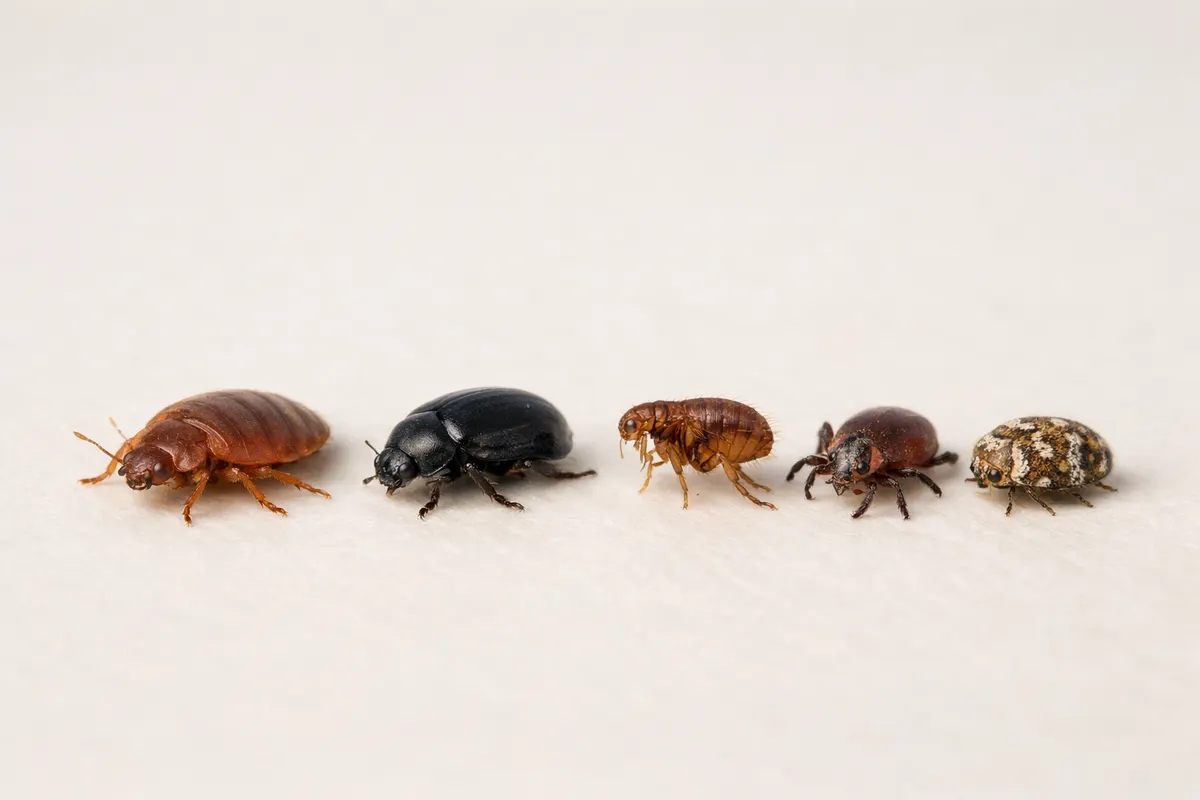
Quick answer: what matters for bed bug lookalikes
If you suspect a small brown insect is a bed bug, the strongest immediate clues are body shape, visible segmentation, leg placement, and the context where you found it. These features tend to survive different lighting and are visible in ordinary phone photos if you get close and steady.
Color alone is a poor differentiator because many insects and debris can be similar shades. Instead, check whether the insect has a flattened, oval body with short, broad edges; visible antennae with segmented tips; and six legs that attach near the head and thorax. Those traits point toward a true Cimex species more reliably than shade or gloss.
Think in probabilities: a flattened, wingless, reddish-brown insect found in a mattress seam at night is more likely a bed bug than a tiny dark round beetle found on a windowsill. But no single visual trait proves identity by itself — location, time of day, and behavior combine with physical clues to raise or lower confidence.
If you need a quick next step after taking a clear photo, inspect the immediate environment for droppings (tiny black dots), shed skins, or live nymphs. Those contextual marks, together with the physical clues above, form a stronger case than an isolated specimen or fuzzy photo.
- Strongest immediate clues: flattened oval body, short broad shape, segmented antennae, and leg placement.
- Context matters: mattress seams, bedframes, and nighttime activity increase the likelihood of real bed bugs.
- Don’t over-rely on color, size estimates from a single image, or a single view of the insect.
Most reliable clues for telling bed bug lookalikes apart
Photographs often vary in color and contrast, so prioritize clues that remain reliable across conditions. For bed bug lookalikes, the most durable visual traits are body outline (flattened versus rounded), apparent wing development (wingless or wing pads versus fully winged), visible segmentation of the abdomen, and distinct antenna segments. These features are less affected by white balance or glare.
Body outline: Adult bed bugs have a broad, flat, teardrop or oval silhouette when unfed; after feeding their bodies swell and become more domed. Many beetles have a more rounded or elongated body with a hard, shiny elytra (wing cover) that creates a distinct seam down the middle. Look for that central seam and the hard gloss of beetle elytra as a counter-signal to bed bugs.
Antennae and legs: Bed bugs have four-segmented antennae with a slender appearance and legs that extend from the thorax in a way that can make the insect look ‘walkable’ rather than tightly tucked. Fleas are laterally flattened and have long, powerful hind legs for jumping; that leg shape and placement can usually be seen even in casual photos. Hard ticks are rounded, lack visible segmentation like insects, and don’t have antennae — they also appear as a single compact body with legs projecting from the front region.
Surface texture and wing evidence: Carpet beetles and other small beetles show hardened, often patterned elytra. If you see symmetrical patterns, scale-like hairs, or a clear division between two hardened plates, you’re likely looking at a beetle. True bed bugs lack hardened elytra and will not show wing veins or a distinct wing seam.
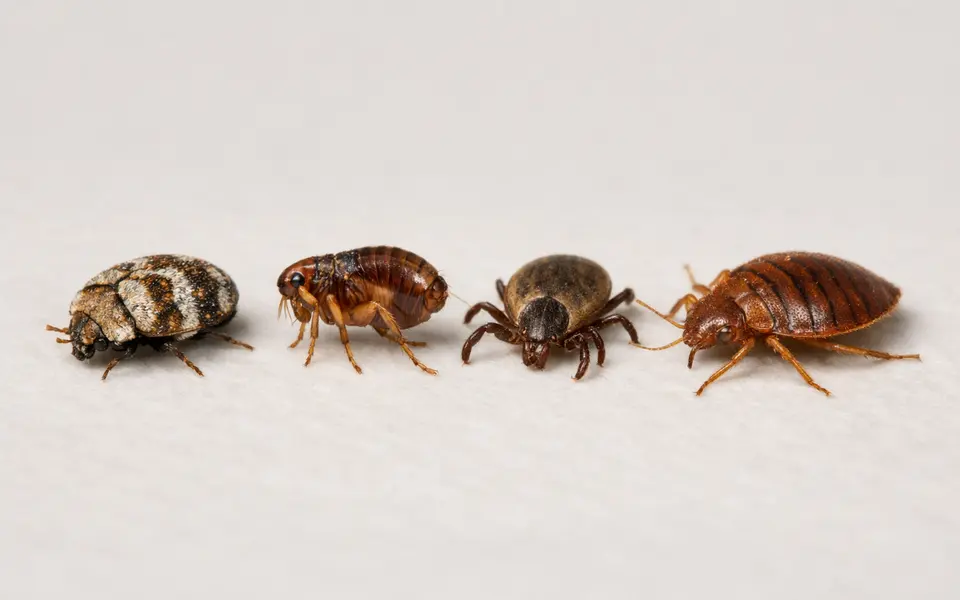
- Body shape: flattened, broad oval (bed bug) vs rounded/elongate with elytra seam (beetle).
- Wings: wingless or wing pads for bed bugs; full wing covers or visible wing veins indicate beetles or true flying insects.
- Legs: jumping-optimized hind legs suggest fleas; powerful front legs and stout bodies suggest ticks or nymph stages.
- Segmentation: clearly segmented abdomen with visible sutures favors bed bugs; smooth domed bodies favor ticks.
Weak signals that make lookalikes look like bed bugs
Some details are routinely misleading in photos. Color shifts from phone auto-exposure, scale, and specular highlights can make harmless debris, seeds, or cast skins look like insects. A small dark speck photographed at low resolution is almost impossible to identify reliably; treating color and apparent size as proof often leads to misidentification.
Glare and angle problems obscure important features. Overhead flash can flatten texture and hide antennae, while extreme side lighting emphasizes surface sheen and may make a beetle’s elytra look like a bed bug’s body. Take multiple shots from different angles without flash when possible; but remember a single image remains a weak basis for certainty.
Behavioral inferences from a single still photo are also weak. A specimen photographed on a mattress might have been placed there by a person, or it could be a beetle that wandered in. Only live observation or multiple finds in expected bed bug harborage (mattress seams, headboard cracks) should increase your confidence.
Scale without reference is another weak signal. Estimating size from distance or unfamiliar backgrounds regularly yields errors. Instead, place a familiar object — a coin, ruler, or the edge of a sheet — near the specimen for scale in subsequent photos if you need to compare size accurately.
- Color: avoid trusting hue or shade alone — lighting changes it too much.
- Single angle: one view can hide antennae or legs; get multiple angles.
- Small dark specks: could be debris, dried blood, or fecal dots rather than insects.
- No scale: add a coin or ruler to photos to provide reliable size context.
How to compare bed bugs, beetles, fleas, and ticks step by step
Comparing candidate identities is a process of elimination: start by verifying which broad class the specimen belongs to — insect (six legs, antennae), arachnid (eight legs, no antennae), or debris. That first split eliminates many lookalikes quickly. For example, if you see antennae and six legs, you can rule out ticks and focus on beetles, fleas, or true bugs.
Next, inspect the body outline, wing evidence, and leg adaptations. If the specimen shows a clear midline seam and hardened elytra, mark beetle as the primary hypothesis and compare fine details such as color pattern and body hair. If it lacks wing covers and shows a flattened oval outline, bed bug remains likely; confirm by looking for abdominal segmentation and antennal structure.
Combine physical clues with context checks: where was it found, what time, and were there other signs (fecal spots, shed skins, live nymphs)? That combined evidence can raise your confidence appropriately. A single match in appearance without supporting contextual clues should be treated as tentative.
Finally, record and compare with trusted references. Use a checklist approach: (1) class (insect/arachnid), (2) body outline (flattened/rounded), (3) wings or elytra, (4) legs and antennae, (5) contextual signs. Tally how many items match the bed bug profile before you act. That structured comparison reduces the chance of false positives from lookalikes.
- Step 1: Class — count legs and check for antennae to separate insects from arachnids.
- Step 2: Outline — look for flattened oval vs domed rounded bodies.
- Step 3: Wing evidence — elytra seam or wing veins rules out bed bugs.
- Step 4: Context — mattress seams, fecal dots or shed skins strengthen bed bug ID.
- Step 5: Tally — use a small checklist to measure how many bed bug traits you actually see.
Using Bug Identifier after you check the lookalike clues
After you collect photos and checklist notes, treat an app as a research partner, not a final authority. Apps are helpful for narrowing possibilities and pointing to likely lookalikes, but they cannot prove identity from one image alone. Enter your photos alongside context notes — where you found the specimen, the time, and any nearby signs — to get more useful, contextualized suggestions.
If the app suggests a beetle, flea, tick, or bed bug, revisit the strong clues you recorded. Do the antennae and leg counts line up? Does the app’s suggested family match the presence or absence of elytra or wing pads? Use its suggestions to guide your next physical checks (for example, inspect mattress seams, headboards, and baseboards if the app returns bed bug-related matches).
Keep a cautious log: record the app’s top suggestions and your supporting evidence so you can show a pest professional if needed. If you decide to consult an expert, having structured photos and a short checklist increases the professional’s ability to triage the case quickly and accurately.
For further reading on visual clues and how to organize your photos and notes, see the Bug Visual Checklist: Common Clues, Lookalikes, and Next Steps for a compact reference you can use alongside app results. Use app results as a first pass and follow up with the checklist and in-person inspection where possible.
- Add context notes with your photos: location, time of day, and nearby signs.
- Treat app suggestions as hypotheses to test, not proof.
- Keep a short evidence log you can share with a pest professional if needed.
- Use the app to prioritize which physical checks to run next (mattress seams, headboard cracks).
Related guides
Try Bug Identifier as your next research step
After you’ve followed the checklist and gathered clear photos plus contextual notes, use Bug Identifier to narrow likely matches and prioritize physical checks. Treat the app’s suggestions as hypotheses to test — record the app’s top results alongside your checklist and use them to decide whether to inspect seams, search for shed skins, or consult a professional. Bug Identifier helps you move from uncertain photos to organized evidence, but it does not replace in-person verification when stakes are high.

Frequently asked questions
What are common bed bug lookalikes examples I might find in my bedroom?
Common lookalikes include carpet beetles, which are small and rounded with patterned elytra; bat or bird mites, which are tiny and move quickly; fleas, which are laterally flattened with powerful hind legs for jumping; and small beetles or seed bugs that wander into bedding. Each has distinguishing features: beetles show a hard wing cover seam, fleas have long hind legs, and mites are much smaller and lack visible antennae. Use multiple photos and context (where and when you found the specimen) to separate these possibilities.
How can I tell a flea from a bed bug in a photo I took on a carpet?
Fleas are laterally flattened and have very long, powerful hind legs adapted for jumping; you’ll often see a pronounced curve to the hind legs even in photos. Bed bugs are broader and have a more oval profile with legs that extend from the sides but are not modified for leaping. Also check for behavior: fleas move quickly and jump, while bed bugs move more slowly and hide in seams or crevices. If you’re unsure, add a scaled object in a subsequent photo and capture multiple angles to compare leg shape clearly.
What immediate signs should I look for if I think I found bed bugs in a mattress?
In mattress situations, look for dark fecal spots clustered along seams and around tufts, rusty or reddish stains, small pale shed skins (nymph exuviae), and eggs or egg shells in crevices. Live adults or nymphs in seams and zipper areas are a strong contextual clue. Photograph these signs alongside a clear specimen shot; combined evidence makes a much stronger case than a single loose insect on a sheet.
How do I use visible clues when a specimen is badly blurred or tiny in a photo?
If the image is blurred or the subject is tiny, focus on collecting better evidence rather than guessing. Take close-up shots from multiple angles without flash, include a coin or ruler for scale, and photograph the surrounding area for context. If you can’t get clearer photos, note contextual markers (where you found it, time, related stains) and treat any app or visual ID as provisional. When in doubt, keep specimens in a sealed container and consult a local pest professional for confirmation.