Flying Insects in House: Wings, Body Shape, and Sources
Identify useful photo clues for flying insects in house, learn common lookalikes, and follow a step-by-step checklist before trusting a single picture.
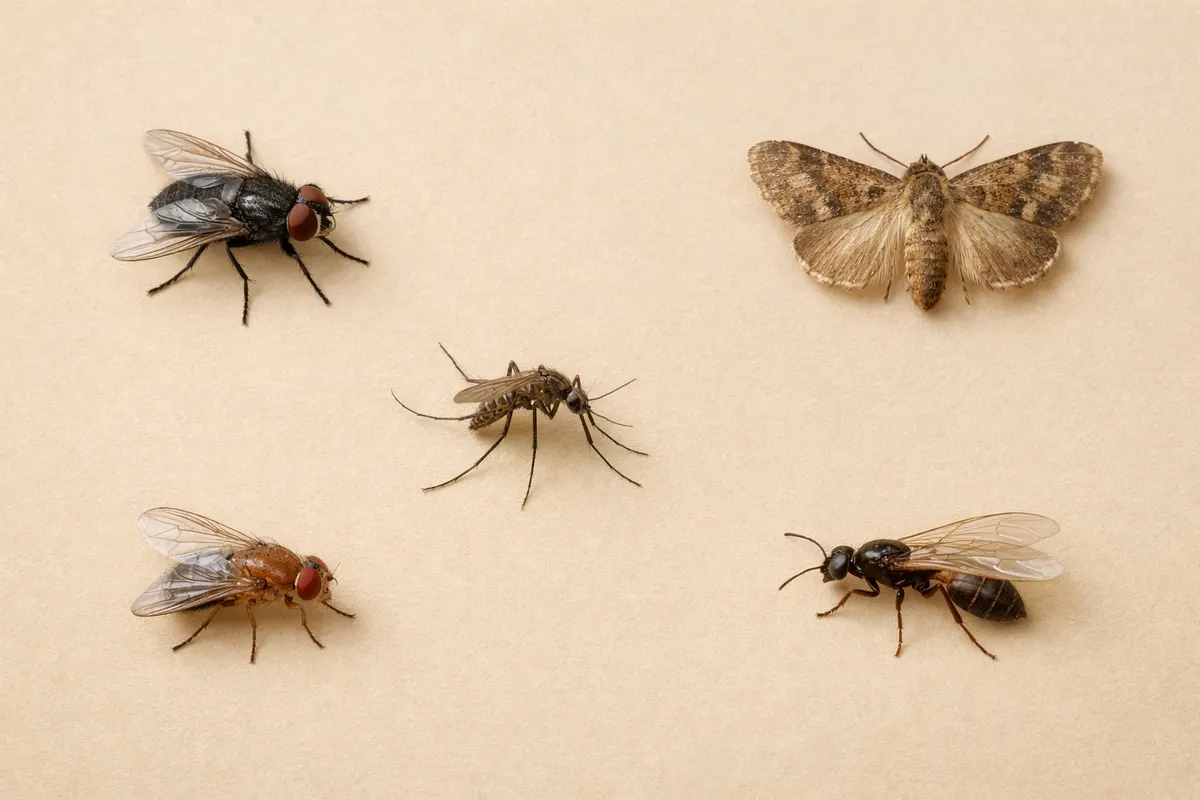
Quick answer for flying insects in house
A clear photo can quickly tell you whether a flying insect in house belongs to a broad group — for example, a one-winged fly (Diptera) versus a two-winged moth or wasp (Lepidoptera or Hymenoptera). The most reliable visual signals are wing count and resting wing posture, overall body outline (slender, humpbacked, or moth-like), and obvious habitat clues visible in the frame, like fruit bowls or drains.
What a single photo rarely proves: precise species, life stage, toxicity or how it entered the house. Small details such as exact wing venation, subtle color patterning, or antennal microstructure are usually too fragile in typical phone photos. Treat a single image as a strong hint, not final proof.
If you need a practical next step after taking a photo, check for context clues in the same image (nearby food, moisture, or fabrics), take one close-up and one environmental shot, and jot down time and location. These extra notes multiply the usefulness of your photo when comparing lookalikes.
- Reliable photo clues: wing count, wing resting position, overall silhouette, visible habitat.
- Weak or unreliable from one shot: exact color details, tiny venation, subtle antenna structure.
- Follow-ups: different angles, a scale reference, and environmental photos (drain, fruit bowl, window).
Strongest visual clues for identifying house flyers
Start with wing count and placement. Diptera (true flies) have one pair of functional wings and a pair of halteres; they often hold wings flat or slightly open and show a compact, hump-backed thorax. In contrast, moths, butterflies, and many wasps have two pairs of wings; moths typically rest with wings roof-like over the body or folded flat, and many wasps hold their wings along the sides.
Body silhouette and proportion survive poor lighting better than color. Look for a narrow waist (common in many wasps), long spindly legs and proboscis (mosquitoes and some moths), or a stout, round body with large eyes (house flies). The silhouette also separates delicate-bodied insects like lacewings from more robust species like hoverflies.
Antennae length and shape are diagnostic at a glance. Long, threadlike or feathery antennae suggest many moths and some mosquito groups; short, bristle-like antennae are common on many true flies. Even without magnified detail, antenna silhouette can rule out entire groups.
Context anchored inside the photo is powerful. Fruit flies and vinegar flies repeatedly occur near overripe fruit or compost, drain flies cluster near sink drains and often look moth-like with rounded wings, and midges or gnats may gather near houseplants. Combining silhouette clues with the visible environment elevates confidence far more than either alone.
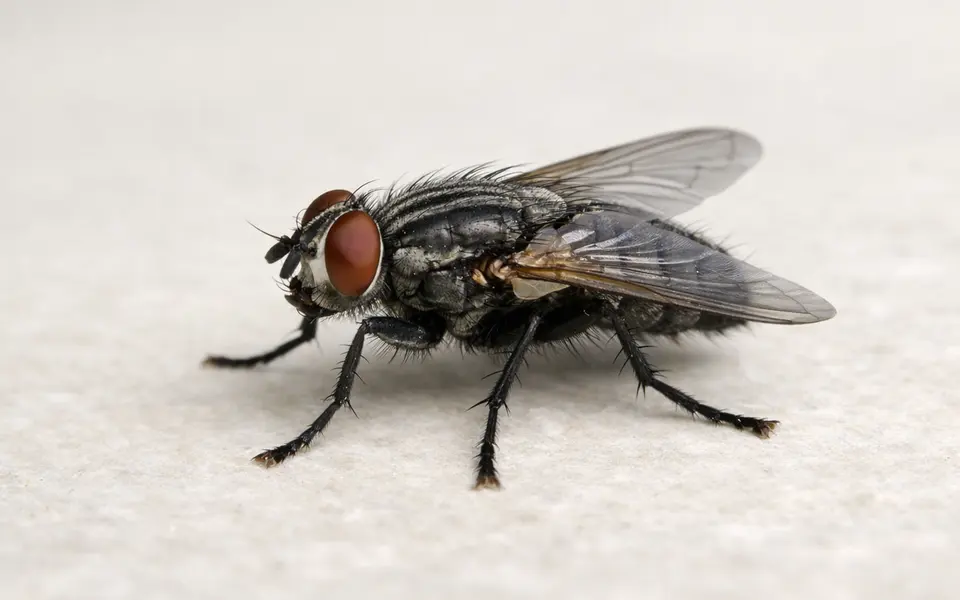
- Wing count (one vs two pairs) — quickest group-level split.
- Resting wing posture — roof-like (many moths) vs flat or spread (flies, wasps).
- Overall silhouette — slender, humpbacked, stout, or elongated.
- Antennae shape and length — short bristles vs long/feathery.
- Environmental context — fruit, drains, lights, plants, fabrics.
Weak signals
Color and sheen are often misleading. Phone white balance, flash, and shadows can shift hues dramatically; a gray moth may look brown under warm indoor light, and glossy black flies can pick up green or purple highlights. Don’t rely on color alone to separate species or even genera.
Scale without reference is a frequent trap. Small fruit flies, midges, and some gnats can all appear similar in a cropped image. Always include an object for scale if possible — a coin, a ruler, or a fingertip — or take a wide shot that shows nearby items like cups or fruit to help estimate size.
Single-angle photos and motion blur hide key traits. A blurred wing edge or a tucked leg can mimic or erase diagnostic features. If only one angle exists, treat any micro-trait (tiny spots, fine hairs, wing venation) as questionable. Damaged or missing body parts also create false impressions; an incomplete insect isn’t representative of the living animal.
- Color shifts from lighting and camera settings make hue unreliable.
- No scale in the frame obscures size, a crucial diagnostic cue.
- Motion blur can erase wing shape and antenna details.
- Torn or missing wings and faded scales (moths) create lookalikes.
Comparison workflow
Work through a short checklist instead of hunting for a single perfect trait. Step 1: group-level split — count wings in the photo or note wing posture. Step 2: silhouette match — compare body shape and leg length. Step 3: antennae and mouthparts — even rough length clues help. Step 4: context check — did the photo show a kitchen counter, a sink drain, a window light or potted soil?
Apply elimination rather than exact matching. For example, if the insect shows one functional wing and short antennae, you can eliminate wasps and moths immediately and focus on fly families (e.g., house fly vs phorid vs drain fly). If the wings are roof-like and scales appear dusted on the wings, moths move to the top of your candidate list.
Compare lookalikes with concrete, paired contrasts. Fruit flies (Drosophilidae) are tiny, often near fermenting fruit, and have distinctive red eyes in good light; drain flies (Psychodidae) are moth-like, broad-winged, and cluster near drains. Phorid flies can have a humpbacked thorax and run erratically across surfaces rather than flying smoothly. Use two or three paired contrasts like these to narrow candidates.
Keep a short record for each candidate: name or group, three photos that support it (close, side, environment), and anything that contradicts it. This simple audit trail prevents confirmation bias — you can see why one option was favored and what evidence is still missing before you seek external help.
- Checklist: wing count → silhouette → antennae/mouthparts → context.
- Eliminate whole groups early (one wing vs two wings) to reduce options.
- Use paired contrasts for common lookalikes (fruit fly vs drain fly, moth vs small wasp).
- Log supporting and contradictory photos to avoid confirmation bias.
App workflow
An identification app is most helpful once you’ve gathered clear photos and contextual notes. Prioritize uploading or scanning multiple perspectives: a close-up showing body and wings, a side profile showing silhouette, and an environmental shot that captures the likely source (fruit bowl, sink, window frame). If the insect is alive and mobile, a short video clip can show flight pattern — useful for separating hoverflies from bees or wasps.
Include context in your notes: where you found the insect, what it was near, time of day, whether it was alive or dead, and whether multiple individuals were present. These non-visual clues often tilt an identification when images are ambiguous — for example, many tiny vinegar flies appear only around fruit and compost, while drain flies cluster by drains and damp organic matter.
Treat app results as research notes, not final authority. A well-designed tool speeds comparison and suggests likely groups, but it can’t guarantee species-level certainty from a single photo. Use the app’s suggestions to inform practical next steps: targeted checks in the home (cleaning fruit bowl, checking trap or drain), or consulting an expert when the insect could imply structural risk (e.g., swarm of winged termites) or health concern.
If you want a structured reference, consult a broader visual checklist to reinforce your comparison workflow. Bug Identifier’s editorial resources and the Bug Visual Checklist: Common Clues, Lookalikes, and Next Steps are useful follow-ups when you need a systematic refresher before relying on a single app result.
- Scan or add at least three images: close detail, side profile, and environment.
- Record contextual notes: location, time, quantity, and nearby materials.
- Use app suggestions as tentative leads; follow up with home checks.
- Refer to a visual checklist (see Bug Visual Checklist) for systematic comparison.
Related guides
Check clues, then use Bug Identifier as a first-pass
After you’ve photographed multiple angles, added context notes, and ruled out obvious lookalikes, try Bug Identifier on your phone to surface likely matches and next checks. Treat the app’s suggestions as research leads: combine them with home inspections (fruit bowl, drains, potted soil, windows) and keep photos that support or contradict each possibility. If an identification matters for safety or property, follow up with a local expert using your photos and notes.

Frequently asked questions
Can I identify every flying insect in house from a single photo?
No. A single clear photo can usually place a flying insect in a broad group (flies vs moths vs wasps), but species-level identification often needs multiple angles, scale reference, or microscopic details. Use one photo as a starting point: gather additional views and context before concluding, especially if the insect could indicate a pest problem or health risk.
Which in-house sources produce the most flying insect lookalikes?
Common lookalike hotspots are kitchen counters (fruit flies vs phorid flies), sink drains (drain flies vs small moths), potted plants (fungus gnats vs phorid or shore flies), and outdoor-entry points near lights (moths vs moth-like flies). When you photograph a suspect, include a shot of the surrounding area to capture these source clues, which separate lookalikes more reliably than tiny body patterns.
How should I photograph a fast-moving insect indoors?
Use burst or short-video mode on your phone and try to capture three types of frames: a close-up when it rests, a side/profile silhouette, and an environmental shot showing where it was found. Increase light to allow faster shutter speeds (avoid harsh direct flash that washes out scale patterns), and include a visible scale object for size reference. If the insect won’t hold still, a short clip often gives more useful motion cues than a single blurry image.
When should I seek professional help after spotting flying insects in house?
Seek expert help if you see repeated evidence of a breeding source (clusters of drain flies around a sink, persistent fruit-fly outbreaks, or many winged termites/alates), if the insect could pose a health risk (vectors like certain mosquitoes or stinging wasps), or if property damage is possible (wood-damaging insects). Use your photos and notes to document frequency, locations, and any signs of breeding before contacting a pest professional.