Cockroach vs Beetle: Body Shape, Movement, and Habitat
Learn practical visual clues to tell cockroach vs beetle, when each is likely, common lookalikes, and the photo checks worth doing before you decide.
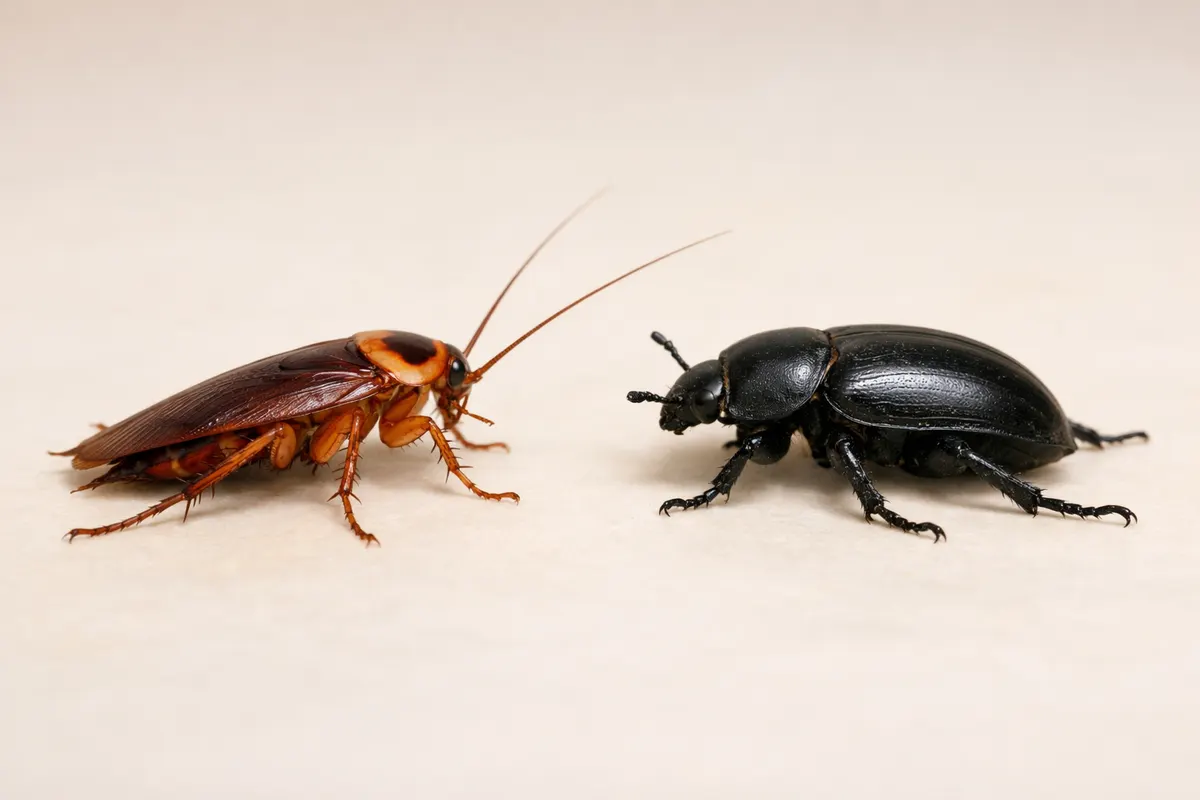
Quick answer: visual clues for cockroach vs beetle
Cockroach vs beetle: the fastest practical split comes down to body plan and wings. Cockroaches tend to have a flattened, elongated body with a shield-like pronotum that can partly cover the head, long filamentous antennae, and legs built for rapid running. Beetles usually have a more rounded or oval body and two hardened wing covers (elytra) that meet in a straight seam down the middle of the back.
Movement and habitat help fast-check the difference. A bug that darts away on long spiny legs when sunlight hits it, or is hiding in warm, damp indoor crevices, is more likely a cockroach. A bug crawling on plants, under bark, or visiting flowers, or one that plays dead when handled, is more likely a beetle.
Photos can show these clues, but expect uncertainty. A dorsal photo that clearly shows antennae, the shape of the thorax (pronotum), and whether the back is covered by hard elytra will go a long way. Single photos taken at odd angles, with glare, or lacking scale often leave room for doubt.
If you need a decision for pest control, safety, or research, pair visible clues with context—time of day, location (indoors vs outdoors), nearby food sources, and behavior—and treat a single image as a first-pass identification rather than a final verdict.
- Cockroach: flattened, elongated body; long, thin antennae; fast, scuttling gait; often indoor or sheltered outdoor locations.
- Beetle: oval/rounded body; hardened elytra forming a straight line down the back; antennae often shorter or clubbed; diverse outdoor habitat.
- Use photos showing dorsal profile, antennae, and habitat context; avoid relying on color alone.
- When in doubt, gather follow-up photos and observations before acting on the ID.
Cockroach vs Beetle: side-by-side comparison
The table below lays out the most reliable photo-visible features and what each usually looks like in a field or home photo. Use the ‘How to inspect in photo’ column as a short checklist for the shots that increase confidence.
Remember that individual species vary and some beetles mimic roaches in shape or color; use the confidence column to decide whether you need follow-up photos or an expert check.
| Feature | Typical cockroach | Typical beetle | How to inspect in photo | Confidence from a single good photo |
|---|---|---|---|---|
| Body shape | Flattened, elongated, often wider at thorax | Oval to rounded, more compact | Dorsal view showing full profile | High |
| Wings | Membranous folded under short or full wings; sometimes visible long wings | Hardened elytra meet in a straight seam | Look for seam and texture of back | High |
| Antennae | Long, threadlike, often longer than head | Shorter, may be clubbed or segmented visibly | Close-up of head or oblique angle | Medium |
| Legs & movement | Spiny legs for quick running; often sprawled posture | Legs adapted for walking, digging, swimming, or grasping | Sequence shots or a short video help here | Medium |
| Habitat | Dark, damp indoor hiding places; kitchens, basements | Plants, soil, decaying wood, lights at night, under bark | Include background or context shot | Medium |
| Size & life stage | Nymphs smaller, wingless – may be confused with small beetles | Larvae (grubs) look very different from adults; adults vary widely | Include scale (coin, ruler, or finger) and note life stage | Low |
When a sighting likely indicates a cockroach or a beetle
Use the cockroach hypothesis when the context and visual clues line up. Common indoor encounters—alive in a kitchen at night, found behind appliances, or seen moving quickly under a countertop or inside baseboards—point to cockroaches. Photographs that show a flat profile, long antennae, and spiny running legs strengthen that conclusion.
Use the beetle hypothesis when the bug was on plants, under bark, in leaf litter, or visiting lights at night. Beetles also often display obvious elytra texture—smooth, ridged, or patterned—that is easier to capture in daylight photos. Beetles frequently have more compact legs and can be seen feeding on leaves, pollen, wood, or other arthropods.
Situations that tip the scale: if you photographed a bug on a flowering plant during daytime, treat beetle as primary candidate; if you found it in a warm drain or near food crumbs after dark, cockroach is more likely. For bites, contamination risk, or pest treatment, prioritize confirmation from multiple clues before acting.
If you only have one indistinct photo taken indoors, weigh location and behavior heavily. For outdoor finds with clear elytra and an obvious seam down the back, a beetle ID is often safe from photos alone. Life stage is important—juvenile cockroaches (nymphs) lack wings and can be mistaken for small beetles, so context and additional photos help.
- Likely cockroach: indoor, night, flat profile, long antennae, fast scuttle.
- Likely beetle: outdoors, on plants or wood, visible elytra seam, plays dead or crawls slowly.
- If photo shows wing covers meeting in a straight line, favor beetle.
- If photo shows a shield-like plate covering the head area, and long legs designed for sprinting, favor cockroach.
Why cockroaches and beetles get mixed up
Several beetle groups and some juvenile insects can resemble cockroaches at a glance. Flat-bodied wood-boring beetles and certain longhorns have elongated profiles and brown or black coloration that looks roach-like in low-resolution photos. Conversely, small cockroach nymphs without wings can appear beetle-like because they lack the full adult roach silhouette.
Photographic issues amplify confusion. Photos taken at an oblique angle can hide the elytral seam, and glare on glossy beetle backs can smooth away texture cues. Blurry close-ups may make long antennae hard to see, and shadow can flatten the subject so a rounded beetle looks elongated.
Behavioral misreads are common too. Some beetles are fast runners and will dart away quickly, which people interpret as a roach trait. Some cockroaches will remain still or fly (depending on species), which is a beetle-like response for casual observers.
Human bias matters: if you expect to see a pest in your kitchen, you'll interpret unclear photos as cockroaches; if you expect to find a garden insect, you’ll more readily call the same photo a beetle. That’s why objective photographic evidence is important, and why verification steps matter.
- Lookalike beetles: certain ground beetles, wood-borers, and longhorns can mimic roach color and elongation.
- Life stage issues: roach nymphs vs small beetles—wings absent vs elytra present but not obvious.
- Photo pitfalls: bad lighting, lack of dorsal view, no scale, or heavy shadowing.
- Behavior traps: quick movement doesn’t always mean cockroach; stillness doesn’t guarantee beetle.
Verification path
Follow a short, repeatable verification path when a cockroach vs beetle decision matters. Start with better photos: dorsal (top-down) and oblique shots, a close-up of the head to show antennae and pronotum, and a context shot that includes where you found it. Add a scale reference—coin, ruler, or a finger—so size is not guessed.
Capture behavior if you can: a short phone video showing whether the insect runs, flies, or plays dead adds more evidence than a single still. Note time of day and immediate habitat—kitchen countertop, under leaf litter, inside a log—as this contextual information frequently resolves uncertainty.
Use morphological checks that are photo-friendly: look for the straight seam of elytra; check whether the pronotum (thoracic shield) covers the head; inspect antenna length and shape; and note leg form (long spiny runner legs versus shorter walking legs). If you can safely coax a view without touching, do so; otherwise, take multiple photos from safe distance.
If you still need help, consult a short checklist or trusted reference: the Bug Visual Checklist (Bug Visual Checklist: Common Clues, Lookalikes, and Next Steps - https://bug-identifier.app/blog/bug-visual-checklist) outlines the exact shots and context notes that increase ID confidence. After you’ve gathered these photos and observations, use an identification app or an expert resource as a first-pass, then treat results as provisional and keep notes for professional follow-up if necessary.
- Photo checklist: dorsal view, head close-up, side profile, habitat/context photo, scale object.
- Behavior checklist: running, flight, feeding, playing dead—use short video to document.
- Morphology checklist: elytra seam, pronotum coverage, antenna length/shape, leg form.
- If pest control or health is at stake, combine visual ID with a field guide, local extension, or a pest professional.
Related guides
Use Bug Identifier after you collect visible clues
Gather the photos and context described above, then use Bug Identifier as a first-pass check to prioritize follow-up. The app is helpful when you have dorsal shots, a head close-up, and a quick video of movement; it can flag likely beetles or cockroaches and suggest next steps. Remember that app results are a research aid—not a substitute for professional advice—so treat uncertain or high-stakes identifications as provisional and keep your photos and notes for verification. Download Bug Identifier on iOS to run a quick scan of your images after you collect the checklist shots and context.

Frequently asked questions
Can I tell cockroach vs beetle from one photo?
Sometimes, but not reliably in every case. A clear dorsal photo showing the full body profile, the back (to check for an elytra seam), and the head with antennae can be enough. However, poor lighting, odd angles, small size, or juvenile stages reduce confidence. Treat a single photo as a strong clue when it shows the key traits, and as a tentative note when it doesn’t—follow up with additional photos or context before acting on the identification.
What are the quickest photo clues to prefer for cockroach vs beetle difference?
Prioritize a top-down shot that captures the entire body, plus a close-up of the head and antennae. Look for a straight seam down the back (beetle elytra) and for a shield-like pronotum that may cover part of the head (cockroach). Add a scale object and a habitat shot to increase confidence. If you can, include a short video to show movement.
Why do some beetles look like cockroaches?
Convergent shapes and coloration cause the resemblance. Some beetles are flat, elongated, and brown or black—adaptations for crawling under bark or leaf litter—that make them look roach-like in small, low-quality images. Juvenile insects and worn beetles (with lost or damaged elytra texture) add to the confusion. That’s why multiple angles, scale, and behavior notes are important to separate them.
If I suspect a cockroach, should I treat it differently than a beetle?
Yes—reasoning and follow-up differ. Cockroach sightings indoors often call for hygiene checks and pest control steps because of health and contamination risks; they reproduce in sheltered human structures. Beetles found outdoors usually don’t require the same response and can be part of local ecology. Always confirm with clearer photos or a professional opinion before using pesticides or other control measures.