Pantry Bugs: Beetles, Moths, Larvae, and Food Clues
Use visible clues, context, and a simple comparison workflow to evaluate pantry bugs like beetles, moths, and larvae and decide safe next steps.
Quick answer: reading pantry bugs by visible clues
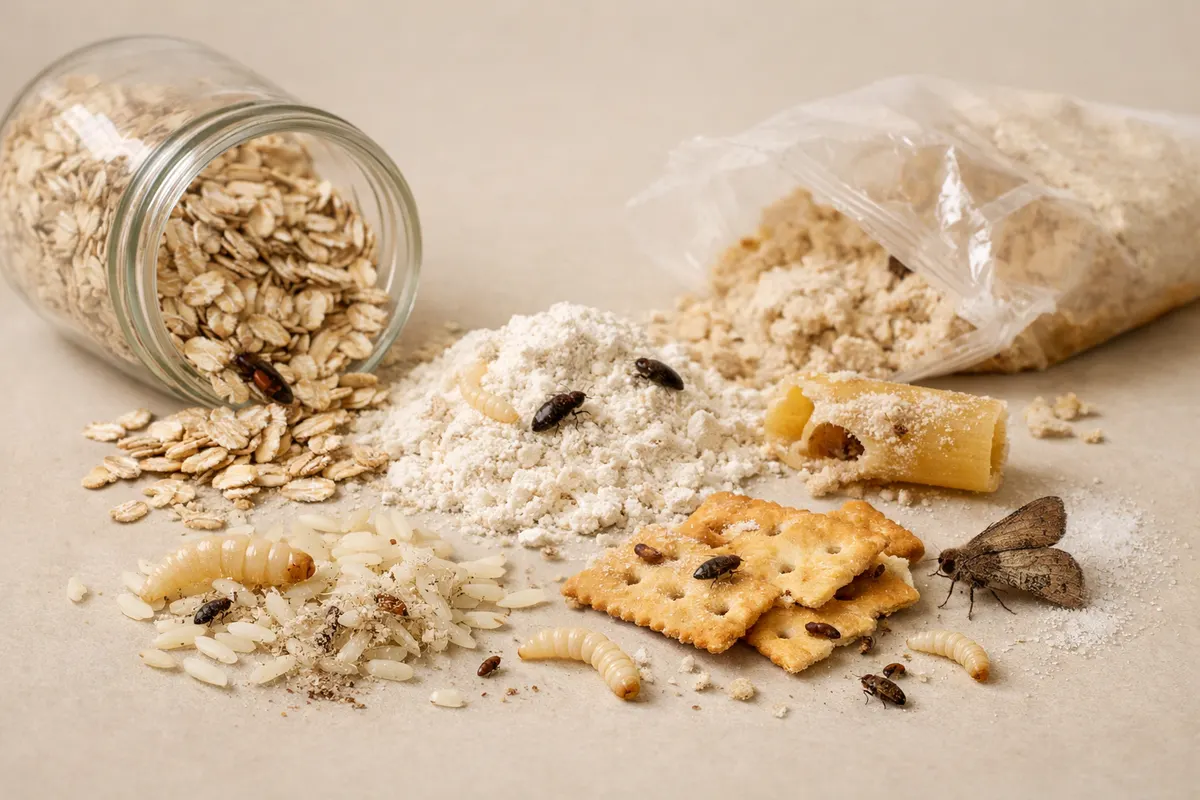
Pantry bugs are a predictable set of pests you usually notice in storage areas and food packages: small beetles (like flour or drugstore beetles), moths (Indian meal moths and relatives), and larvae (tiny grubs or caterpillars that feed inside grains and dried goods). The strongest clues you can rely on from a quick look are where you found the insect, what it's near or inside, the pattern of damage or debris, and broad body shape (beetle, moth, or caterpillar/larva). These clues narrow the field quickly, even if a photo can't prove species.
Realistically, a single photo can tell you category and common behavior—whether you’re looking at a winged adult moth fluttering around light and packaging, a tiny round beetle crawling inside a flour sack, or a soft-bodied larva chewing a seed. But a photo rarely proves exact species because size, stage, and subtle patterns need context: where in the pantry the specimen was found, whether packages are opened or leaking, and whether there’s webbing, frass, or pupal cases nearby.
If your priority is next steps rather than exact naming, use the visible evidence to decide immediate actions: isolate suspect packages, look for spread across containers, and check nearby food types (flours, grains, pet food, dried fruit, spices). Those practical actions are the most useful immediate responses and let you collect better clues for identification later.
- Location: insects inside sealed boxes or loose in the shelf tell different stories.
- Damage pattern: fine powder and tiny holes suggest grain-feeding beetles; silky webbing and surface larvae often mean pantry moths.
- Debris and frass: size and texture of droppings help distinguish larvae from adult beetles.
- Body shape: hard, compact beetle bodies versus soft, segmented larvae or winged moths are the quickest visual splits.
Strong visual clues that hold up in photos
When working from phone photos or a quick in-person look, prioritize clues that don’t change with lighting or a single angle. Start with broad body form: is the insect compact and rounded like a beetle, slim and winged like a small moth, or soft and legged/legless like a larva? That primary split eliminates many lookalikes and directs the rest of your comparison.
Damage and its pattern are highly reliable. Beetle feeders often leave fine powder, tiny round exit holes in kernels or between grains, and sometimes scattered adults crawling through open bags. Pantry moth larvae create silk webbing that matts product together, leave clumps of frass and cast skins, and often pupate on the inner shelf surface rather than inside a sealed container. Photograph the pattern of damage, not just the insect: include the product matrix and any tunnels, holes, webbing, or powder.
Distribution and context are strong clues: finding many tiny beetles crawling inside a single open bag is different from a few moths fluttering around lights and ceiling corners. Note whether specimens are clustered in one package, along seams of boxes, or spread across multiple food types. A cluster inside multi-ingredient cereals or spices points to stored-product pests adapted to that food type; scattered insects around light sources often implicate moths.
Frass (droppings) and remains are surprisingly diagnostic. Beetle frass is usually fine and sand-like; larval frass can be granular and mixed with webbing; adult moths rarely leave frass in bulk but larvae do. Also watch for shed skins, pupal cases, or whole larval bodies. Photograph a close-up of frass texture beside a coin or ruler for scale when possible—scale is often the difference between species-level suspicion and guesswork.
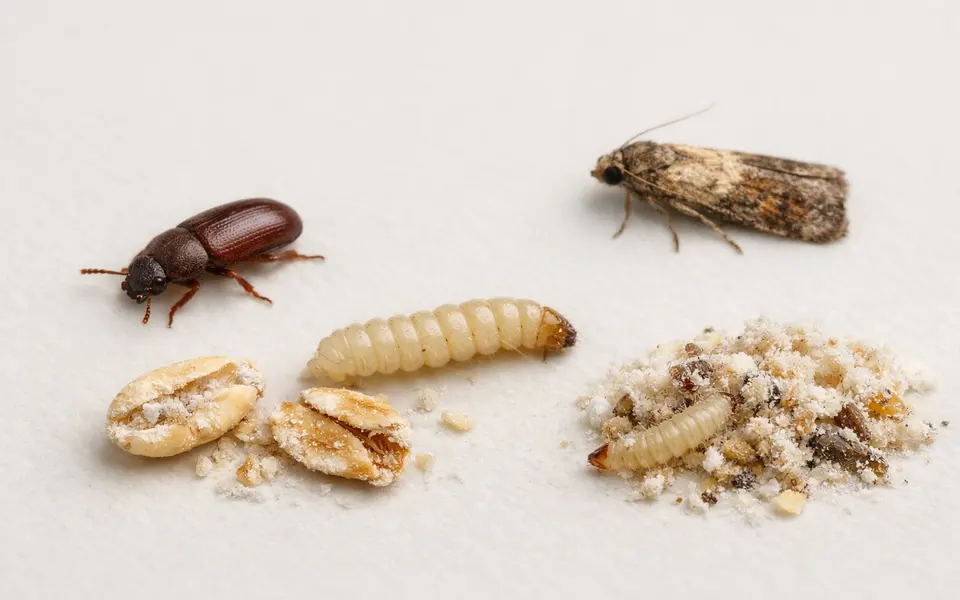
- Primary body shape (beetle vs moth vs larva) is the fastest reliable split.
- Damage pattern: holes/powder → beetles; webbing/clumping → moth larvae.
- Distribution: single-package cluster vs scattered individuals suggests beetle colony vs transient moths.
- Frass texture and cast skins help separate larvae from adult-only signs.
- Food type matters: whole grains favour certain beetles; dried fruit and nuts attract specific moth species.
Weak signals
Some visual signals are tempting but unreliable. Color alone is a weak signal: many pantry beetles are brown, reddish-brown, or tan and lighting/age can change shade. A tiny golden speck in poor light might be a stored-product beetle, a seed fragment, or a grain particle reflecting light. Avoid making identifications based only on hue unless paired with shape and behavior.
Single, blurry photos often mislead on size and texture. Without scale you can’t be sure whether the subject is 2 mm or 8 mm long, and that size range separates very different species and risk profiles. Shallow focus can hide key traits such as wing cover texture on beetles or the presence of prolegs on larvae. Always try for a second photo with a scale object and alternate angles.
Stage confusion is another trap: many insects change pattern or color as they mature. A larval stage can look nothing like the adult moth or beetle it will become. Similarly, dead or desiccated specimens lose sheen and appendages, making them appear different from living examples. Treat color and single-angle detail as supporting evidence rather than primary proof.
Context-less specimens (a single insect on a counter with no product visible) are low-value clues. A moth fluttering across a kitchen late at night could be an indoor-adapted pantry moth or a transient outdoor species attracted to light—context like proximity to opened food, presence of webbing, or repeated sightings matters more than the lone insect photo.
- Color alone is unreliable—lighting and age change appearance.
- Blurry or single-angle photos hide scale and key identifying traits.
- Larval and adult stages can look unrelated—don’t infer adult species from larval color alone.
- Single sightings without product context often point to transient insects, not pantry infestations.
A practical comparison workflow for pantry bugs
Compare multiple clues, not just one. Start by documenting four facts: (1) exact location and affected product, (2) number and distribution of specimens, (3) visible damage patterns (powder, holes, webbing), and (4) body form and movement. Capture photos showing each fact: a wide shot of the shelf, a mid shot of the product and package seams, and a close-up of the insect or frass with a scale object.
Work from broad to narrow: first decide whether you’re dealing with beetles, moths, or larvae. Next, use size and behavior to refine options. For example, tiny, fast-running round beetles found inside flour or cereal are often in the family Dermestidae or Anobiidae (red flour beetle, sawtoothed grain beetle, drugstore beetle); look for parallel grooves on elytra or the characteristic antennae shape. Moths like Indian meal moths have a two-toned wing pattern and produce webbing; their larvae are creamy with a dark head.
Apply elimination steps: if you see webbing that mats product and lumps of fine frass, that rules strongly toward moth larvae even if you find a small beetle nearby (beetles often colonize the same food but don’t produce webbing). If you find round holes in whole kernels and adults running on the surface with sand-like frass, prioritize beetle ID. Record negative clues too: absence of webbing, lack of exit holes, or confined pupal cases help eliminate species groups.
When you have likely matches, cross-check with the food type and infestation pattern. Some species specialize: certain beetles are common in dried herbs and spices, others in whole grains. If you need a second opinion, use a verification workflow: collect a clear set of photos and notes, check a reliable visual checklist (for example, Bug Visual Checklist: Common Clues, Lookalikes, and Next Steps at https://bug-identifier.app/blog/bug-visual-checklist), and treat any automated or app-based suggestions as research notes rather than final proof.
- Document four facts: location, distribution, damage, body form.
- Photograph wide, mid, and close shots—include a scale object.
- Decide beetle vs moth vs larva first, then refine by size and behavior.
- Use elimination: webbing → moth larvae; holes/powder → beetles.
- Cross-check likely matches against the product type and spread pattern.
Using an ID app after you collect visible clues
An identification app can be a useful next step after you’ve gathered the visible clues above. Don’t open the app as your first move; instead, use it to scan the photos and notes you already made so automated suggestions have the richest context. Apps are best used as a way to narrow possibilities and suggest similar species or lookalikes to check, not as definitive answers.
When you prepare images for scanning: include a scale object in at least one close-up, photograph the damage pattern and any webbing or frass, and capture the specimen from multiple angles if it’s safe to do so. If the insect is alive, a quick short video showing movement can reveal running beetle legs or larval locomotion, which are strong behavioral clues for comparison. Keep photos crisp and well-lit; avoid heavy shadows and backlighting that obscure texture.
After you run the photos through an app, use the app’s suggestions as a prioritized checklist: compare the suggested matches against your earlier elimination steps (food type, frass, distribution). If results are uncertain or multiple matches are plausible, treat them as research notes and collect a few more photos or a sample if safe. Avoid relying solely on one app output to make disposal or chemical-control decisions.
If you want more guidance on visual clues and next steps before or after using an app, consult general visual checklists that cover lookalikes and safe handling. The Bug Visual Checklist (see internal guide linked above) offers a checklist-style approach you can crosswalk against any app suggestions. For infestations that are spreading rapidly, or when a food product must be recalled or discarded in bulk, consider contacting a local pest professional rather than relying only on images and app output.
- Collect full-context photos first, then scan them in the app.
- Include scale, multiple angles, damage pattern, and frass in images.
- Treat app suggestions as hypotheses to test, not final IDs.
- If infestation spreads fast, consult a local pest pro for control.
Related guides
Use Bug Identifier after your clue checklist
After you collect photos and notes—location, damage pattern, frass, and multiple angles—scan those images with the Bug Identifier app on iOS to get suggested matches you can cross-check. Treat app results as research notes: compare them to the clues you recorded, add more photos if suggestions are uncertain, and take practical next steps (isolate or discard affected food, clean shelves). For infestations that spread or threaten stored stock, contact a local pest professional for confirmation and treatment advice.

Frequently asked questions
Can I tell if pantry bugs are harmful to my food just from a photo?
A photo can usually tell you whether food has been contaminated (webbing, frass, or visible larvae inside a package) and whether the pest type is one that feeds on stored goods (beetles or moth larvae). However, photos can’t reliably measure microbial contamination, toxins, or health risk. If you find visible live insects, webbing, or frass in a product, discard it or isolate it and clean the storage area; for large-scale contamination or food you intend to sell, consult a lab or professional for safety guidance.
How can I safely collect a specimen or sample for identification?
Use a clean small container or sealed plastic bag and place the specimen inside with a folded paper towel to prevent crushing. Photograph the specimen from multiple angles before sealing it, and note where and when you found it plus what product it was in. Label the sample with date and product name if you plan to seek a professional ID. Avoid using bare hands with unknown pests—use gloves or a folded paper to transfer live insects.
Are dead insects in a pantry still useful for identification?
Yes. Even dead or desiccated insects can show structural traits—overall shape, wing covers, legs, antennae, and body segmentation—that help narrow identification. Frass, shed skins, and pupal cases remain informative as well. Keep in mind that color and sheen may be distorted after death, so pair dead specimens with notes about where they were found and what product showed damage.
When should I call pest control instead of relying on DIY checks?
Call a pest professional if infestations are widespread across many products or shelves, if you continue to find live insects after isolating and discarding affected items, or if the infestation involves high-value stock you must protect. Professionals can perform targeted inspections, identify species with more certainty, and recommend treatment plans. For a single small package with a few insects, isolation, disposal, and a focused clean of nearby shelves often suffice.